Why Paying Medical Bills Without Negotiating Is a Mistake
Blog post description.
8/27/202610 min read

Why Paying Medical Bills Without Negotiating Is a Mistake
Most people who pay a medical bill in full, immediately, and without question are not doing so because they believe the bill is fair. They pay because they are scared, overwhelmed, exhausted, or afraid of what will happen if they don’t.
In practice, this often happens after a stressful medical event—an ER visit, a surgery, a hospital stay, or a diagnostic test that spiraled into something larger than expected. By the time the bill arrives, the patient is no longer focused on healthcare decisions. They’re focused on damage control.
And that is exactly the moment when hospitals and billing departments have the most leverage—unless you understand how the system actually works.
Over years of observing and assisting real medical billing situations, one pattern repeats again and again:
Patients who pay immediately are often the ones who overpay the most.
Not because they are irresponsible.
Not because they are careless.
But because they were never told that medical bills are not final prices in the way most other bills are.
This article explains, in depth, why paying medical bills without negotiating is a mistake—and what actually happens behind the scenes when you do.
This is not theory.
This is not generic advice.
This is how medical billing functions in the real world. https://medicalbillnegotiationusa.com/medical-bill-negotiation-playbook
The Assumption That Costs Patients Thousands: “The Bill Is the Bill”
One of the most damaging assumptions patients make is believing that a medical bill represents a fixed, validated, non-negotiable debt—similar to a credit card statement or utility bill.
In many cases we see, that assumption is wrong.
Medical bills are starting positions, not final outcomes.
Hospitals do not bill based on a single universal price list. They bill using internal charge structures that are then:
Adjusted for insurance contracts
Discounted for government programs
Reduced through write-offs
Repriced through patient assistance
Negotiated through payment arrangements
Reworked through appeals and corrections
The number you receive as a self-pay or post-insurance patient often reflects none of those adjustments yet.
When you pay immediately, you lock in the worst possible pricing outcome—the price before any pressure, review, or adjustment has occurred.
Why Hospitals Expect Negotiation (Even When They Don’t Say It)
Hospitals rarely advertise that their bills are negotiable. That silence is intentional.
But operationally, negotiation is built into the system.
One pattern that repeats across hospital billing departments is this:
They expect a percentage of patients to question, delay, or push back.
Those patients trigger internal workflows:
Financial review
Coding validation
Discount eligibility checks
Charity care screening
Payment plan reassessment
Patients who don’t push back bypass all of that.
In practice, hospitals allocate staffing and systems assuming that:
Some patients will pay in full immediately
Some will negotiate
Some will default
Some will qualify for reductions
If you pay immediately, you are treated as the “best possible outcome” from the hospital’s perspective—not because the bill was correct, but because you removed friction.
What We See Most Often in Real Negotiations
Across hundreds of real-world medical billing situations, several patterns repeat with remarkable consistency.
1. Bills Paid Immediately Are Rarely Reviewed Internally
Once payment posts, the account is usually closed.
Closed accounts:
Are not re-audited
Are not reconsidered for discounts
Are not re-coded unless a major error is flagged
In many cases we see, patients later discover:
Duplicate charges
Incorrect CPT codes
Services billed but never received
Higher-cost codes used instead of appropriate lower-cost ones
But once paid, the leverage is gone.
Refunds are possible—but difficult, slow, and often resisted.
2. Self-Pay Patients Are Often Charged the Highest Rates
This surprises many people.
Self-pay patients often assume:
“I don’t have insurance, so I’ll get a cheaper price.”
In practice, this often happens:
The initial self-pay bill reflects the full chargemaster rate
Insurance discounts have not been applied
Cash-pay discounts may exist but are not automatic
Negotiation is what triggers those reductions—not silence.
3. Timing Matters More Than Most People Realize
Patients who negotiate before paying often see:
Larger percentage reductions
More flexible payment terms
Faster resolution
Patients who negotiate after paying are often told:
“The account is already settled”
“There’s nothing we can do”
“You would need to dispute the charge formally”
The same bill produces different outcomes depending on when the conversation happens.
The Emotional Trap: Fear-Based Compliance
Medical bills arrive when patients are emotionally vulnerable.
In many cases we see:
Fear of collections
Fear of credit damage
Fear of legal action
Fear of being “non-compliant”
Billing language reinforces this fear with:
Short deadlines
Capitalized warnings
Threatening phrasing
Legal-sounding terms
This pushes patients toward fast payment, not smart decisions.
But here’s what’s rarely explained:
Negotiating a medical bill is not refusing to pay.
It is participating in a process the system already anticipates.
Common Mistakes Patients Make
Mistake #1: Paying “Just to Get It Over With”
In practice, this often leads to long-term regret.
Patients later realize:
They could have reduced the bill
They qualified for assistance
Errors existed
Payment plans were available
But the emotional relief of “getting it done” came at a permanent financial cost.
Mistake #2: Assuming Negotiation Requires Aggression
One pattern we see repeatedly is patients avoiding negotiation because they believe it requires confrontation.
In reality:
Calm, procedural requests are often more effective
Billing departments respond to structured inquiries
Escalation is rarely necessary at first
Negotiation is usually administrative, not adversarial.
Mistake #3: Waiting Until the Bill Is in Collections
This is one of the most costly timing errors.
Once an account is sent to collections:
Options narrow
Stress increases
Credit implications become real
Original billing flexibility decreases
Negotiation is most effective before that transfer.
Patterns That Repeat Across Hospital Billing Departments
Understanding these patterns changes how you approach every bill.
Pattern 1: Front-Line Agents Have Limited Authority
The first person you speak to usually:
Cannot approve major reductions
Cannot alter coding
Cannot authorize charity care
Their role is information and processing—not decision-making.https://medicalbillnegotiationusa.com/medical-bill-negotiation-playbook
Effective negotiation often involves:
Asking for review
Requesting escalation
Triggering internal processes
Pattern 2: Silence Is Interpreted as Acceptance
If a patient does not question a bill:
It is assumed correct
It is assumed payable
It is assumed final
Billing systems are designed to move forward unless stopped.
Pattern 3: Documentation Changes Outcomes
Patients who:
Ask for itemized bills
Request written confirmations
Keep records of conversations
Consistently see better results.
Not because they threaten—but because they signal engagement.
Why “Discounts” Are Not Charity (And Why That Matters)
Many patients hesitate to negotiate because they believe:
“I don’t want to ask for charity.”
But in practice, many reductions are pricing adjustments, not financial aid.
Hospitals:
Inflate base charges knowing they will be reduced
Expect negotiated settlements
Budget for write-offs
Negotiation is not begging—it is aligning the bill with realistic payment outcomes.
The Hidden Cost of Paying Without Understanding
When you pay a medical bill without negotiating, you lose more than money.
You lose:
Leverage
Transparency
Control
Learning for future encounters
Patients who negotiate once are far better equipped to handle future bills. Those who never do often repeat the same costly pattern again and again.
Decision Framework: Should You Pay Now or Pause?
Before paying any medical bill, ask:
Is this bill itemized?
Has insurance fully processed it?
Have all explanations of benefits matched the charges?
Do I understand what each line item represents?
Have I asked about discounts or assistance?
Have I confirmed payment plan options?
Has anyone reviewed the coding?
If the answer to any of these is “no,” paying immediately is almost always premature.
What Negotiation Actually Looks Like in Practice
Negotiation is rarely a single phone call.
In many cases we see:
One call to request itemization
One follow-up to confirm processing
One escalation for review
One discussion of payment terms or reductions
This is not dramatic.
It is procedural.
And it often results in meaningful savings.
Why This Matters More Than Ever
Medical costs continue to rise faster than wages.
More patients are:
Underinsured
High-deductible insured
Facing surprise bills
Responsible for large balances
Paying without negotiating compounds this pressure.
Negotiation is not optional anymore—it is a survival skill.
The Long-Term Pattern: Who Wins and Who Loses
Over time, we see a clear divide:
Patients who negotiate:
Pay less overall
Experience less stress
Feel more in control
Avoid cascading debt
Patients who don’t:
Overpay repeatedly
Feel powerless
Avoid future care
Accumulate financial damage
The difference is not intelligence or income.
It is knowledge and timing.
A Final Reality Most Patients Are Never Told
Hospitals do not reward speed.
They reward certainty.
When you pay immediately, you give them certainty—on their terms.
When you pause, review, and negotiate, you create uncertainty—and that uncertainty is where leverage lives.
Regaining Control: Your Next Step
If you’re dealing with medical bills and feeling overwhelmed, clarity matters more than speed.
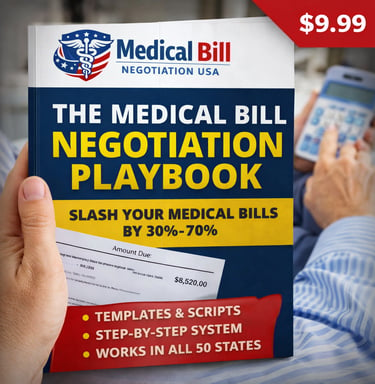
That’s why we created the Medical Bill Negotiation Playbook.
It is designed for real patients under real financial pressure—not theory, not hype.
Inside, you’ll find:
Step-by-step decision paths
Exact sequencing that works in practice
Clear frameworks for when to push, when to wait, and when to settle
Guidance built from real billing patterns, not internet myths
No guarantees.
No sales pressure.
Just a way to regain control, reduce confusion, and stop overpaying when you don’t have to.
If you want clarity before you pay another dollar, the Medical Bill Negotiation Playbook is there when you’re ready.
And that pause—before paying—is often the most powerful move you can make.
continue
make.
What Happens After You Pay: The Door That Quietly Closes
One of the least understood aspects of medical billing is how dramatically the system’s posture changes once payment is received.
Before payment, your account is considered active and unresolved.
After payment, it becomes closed and settled.
That distinction matters more than most patients realize.
In practice, once an account is marked settled:
Internal review queues stop
Coding audits are deprioritized
Financial assistance flags are removed
Supervisory escalation becomes unlikely
Refund requests are treated as exceptions, not processes
In many cases we see, patients who later discover errors are told some version of:
“The account has already been resolved. There’s nothing further we can do.”
This is not always true—but it is much harder to reverse than negotiating before payment.
Hospitals are optimized for forward motion, not backward correction.
The Illusion of “Doing the Right Thing”
Many patients pay immediately because they believe it is morally correct.
They associate payment with responsibility, compliance, and good faith.
Hospitals understand this psychology.https://medicalbillnegotiationusa.com/medical-bill-negotiation-playbook
Billing language often reinforces it with phrases like:
“Amount due”
“Balance owed”
“Please remit payment”
“Past due notice”
What is rarely stated is that questioning a medical bill is not unethical.
In practice, hospitals expect:
Review
Clarification
Adjustment
Negotiation
Those processes exist precisely because the initial bill is not assumed to be perfect.
Paying without negotiation is not virtue—it is uninformed compliance.
How Hospital Pricing Actually Works (The Part Patients Never See)
To understand why negotiation is expected, you have to understand how pricing is built.
Hospitals do not price services the way normal businesses do.
They start with a chargemaster—an internal list of prices that are:
Artificially high
Rarely paid in full
Used as anchors for negotiation
Adjusted downward depending on payer type
Insurance companies never pay chargemaster rates.
Medicare and Medicaid never pay chargemaster rates.
Large employers never pay chargemaster rates.
Self-pay patients are often the only group initially presented with these inflated numbers.
In practice, negotiation is how self-pay patients move from “list price” to “realistic price.”
What We See Most Often in Real Negotiations (Continued)
4. The First Offer Is Rarely the Best Offer
When patients ask for a discount, they often receive a modest reduction—10%, 15%, maybe 20%.
Many assume this is the limit.
In reality, that first offer is often a test:
Are you engaged?
Will you push further?
Do you understand the process?
Patients who politely continue the conversation often see:
Additional reductions
Reclassification of services
Access to financial assistance programs
Stopping at the first “yes” often leaves savings on the table.
5. Documentation Changes the Tone of the Conversation
Patients who reference:
Dates
Line items
CPT codes
Prior conversations
Are treated differently than those who speak generally.
This is not about intimidation.
It’s about signaling seriousness.
In practice, billing departments prioritize cases that demonstrate engagement because those cases are more likely to escalate.
The Dangerous Myth of “It’ll Hurt My Credit Immediately”
Fear of credit damage is one of the strongest drivers of immediate payment.
But in practice, medical billing timelines are slower than most people believe.
Typically:
Initial bills are informational
Follow-up statements repeat balances
Internal collections occur first
External collections come later
Credit reporting happens last
Negotiating early rarely harms credit.
Ignoring bills entirely can—but negotiation is not ignoring.
Understanding the timeline allows you to act strategically rather than react emotionally.
Common Mistakes Patients Make (Continued)
Mistake #4: Confusing Explanation of Benefits With a Bill
An Explanation of Benefits (EOB) is not a bill.
Yet many patients pay based on EOBs alone.
In practice, this often leads to:
Overpayment
Duplicate payment
Paying before insurance adjustments finalize
Negotiation requires waiting for the final patient responsibility, not reacting to preliminary documents.
Mistake #5: Assuming Payment Plans Are Always Fair
Payment plans feel safe.
They reduce immediate pressure.
But in many cases we see:
No reduction in total balance
Long-term financial drag
Missed opportunities for discounts
Payment plans should be evaluated—not accepted automatically.
Patterns That Repeat Across Hospital Billing Departments (Continued)
Pattern 4: Discounts Exist, But Are Not Advertised
Hospitals rarely volunteer discounts.
They wait to be asked.
This includes:
Prompt-pay discounts
Self-pay discounts
Hardship reductions
Internal adjustment policies
Silence is interpreted as acceptance of full charges.
Pattern 5: Persistence Beats Aggression
Patients who remain calm, consistent, and organized almost always outperform those who become emotional or confrontational.
In practice:
Politeness keeps doors open
Documentation creates leverage
Persistence triggers review
Negotiation is a process, not a fight.
The Compounding Cost of Repeated Overpayment
One overlooked reality is that medical billing is rarely a one-time event.
Patients who:
Pay without negotiating once
Do so again and again
Over a lifetime of care
Often lose tens of thousands of dollars unnecessarily.
Each bill feels isolated.
The pattern is cumulative.
Learning to negotiate once changes outcomes permanently.
Why Speed Works Against You
Hospitals operate on volume.
They benefit when accounts move quickly from billing to payment.
Speed favors the system—not the patient.
When you slow the process:
Reviews happen
Errors surface
Adjustments become possible
Pausing is not procrastination.
It is strategy.
The Quiet Power of Asking the Right Questions
Most negotiations begin not with demands, but with questions.
Questions like:
“Can you explain how this charge was calculated?”
“Has this account been reviewed for self-pay adjustments?”
“What options exist before I make payment?”
“Is there a department that reviews billing accuracy?”
These questions signal engagement without confrontation.
In practice, they open doors.
When Paying Immediately Might Make Sense
There are limited situations where immediate payment is reasonable:
Small balances where review costs exceed savings
Fully understood charges after verification
Situations with confirmed prompt-pay discounts
Even then, confirmation matters.
Paying without confirmation is the mistake—not payment itself.
The Emotional Reality: Medical Bills Are Different
Medical bills arrive when people are vulnerable.
They are tied to:
Health scares
Pain
Fear
Uncertainty
This emotional weight clouds judgment.
Hospitals know this.
Negotiation is how patients reclaim agency in a moment designed to strip it away.
A Practical Decision Path Before Paying Any Medical Bill
Before paying, walk through this sequence:
Wait for insurance to finalize
Request an itemized bill
Compare charges to EOBs
Ask about discounts and assistance
Request review if anything is unclear
Negotiate balance or terms
Confirm agreements in writing
Pay based on confirmed outcome
Skipping steps usually increases cost.
Why Knowledge Changes the Power Dynamic
Billing departments are structured to manage volume—not informed resistance.
When patients understand:
The process
The timing
The leverage points
The dynamic shifts.
Negotiation becomes expected, not awkward.
The Most Important Thing to Remember
Paying a medical bill is irreversible.
Negotiating is not.
Once money leaves your account, leverage disappears.
Pausing—even briefly—keeps options alive.
Reclaiming Control Without Conflict
Negotiation does not require:
Threats
Anger
Legal language
Aggression
It requires:
Timing
Questions
Persistence
Documentation
Most patients who try it once realize how different the system feels when they engage.
Final Thought: Paying Is Easy. Paying Smart Is Rare.
Hospitals are designed for payment.
They are not designed for patient clarity.
Negotiation is how patients bridge that gap.
Your Next Step, If You Want Clarity Before You Pay
If you’re facing medical bills and want a clear, structured way to navigate them without panic, the Medical Bill Negotiation Playbook was created for exactly this situation.
It focuses on:
Real sequencing
Practical judgment
Knowing when to push and when to pause
Avoiding the mistakes that cost patients the most
No hype.
No guarantees.
Just a grounded way to approach medical bills with control instead of fear.
Before you pay another medical bill on autopilot, having a framework can change everything.
The decision to pause—and negotiate—often saves far more than people expect.
Help
Lower your medical bills with expert support
Contact
infoebookusa@aol.com
© 2026. All rights reserved.