What to Say to Hospital Billing to Get a Discount
Blog post description.
2/9/202615 min read
What to Say to Hospital Billing to Get a Discount
If you’re staring at a hospital bill that makes your stomach drop, you’re not weak, irresponsible, or alone. You’re exactly where millions of Americans end up every single year: shocked, confused, and quietly panicking over a number that feels completely disconnected from reality.
Here’s the part most people don’t know—but desperately need to know:
Hospital bills are negotiable.https://medicalbillnegotiationusa.com/medical-bill-negotiation-playbook
And what you say matters more than almost anything else.
This is not about being rude.
It’s not about yelling, threatening lawsuits, or begging.
It’s about knowing the exact words, the exact framing, and the exact leverage points that hospital billing departments respond to—because they are trained to respond to them.
This article will walk you through, step by step, exactly what to say to hospital billing to get a discount, why those words work, and how to use them even if you:
Don’t have insurance
Have “bad” insurance
Already received the bill
Are behind on payments
Feel intimidated, embarrassed, or overwhelmed
Nothing here is theoretical. These scripts, strategies, and psychological levers are used every day by professional medical bill negotiators—and by patients who learned how the system actually works.
And yes, people regularly cut bills by 30%, 50%, even 80% or more using these exact approaches.
Let’s start with the most important mindset shift you must make before you ever open your mouth.
The One Truth Hospital Billing Doesn’t Want You to Understand
Hospital billing is not a moral system.
It’s a financial system.
The number on your bill is not:
What the care “cost”
What the hospital expects to collect
What they need to break even
What other patients actually pay
It is a starting number, inflated by design, created for negotiation with insurers—not individuals.
Hospitals expect:
Insurance companies to slash the bill
Government programs to pay fixed rates
A large percentage of patients to pay nothing at all
When you, a regular human being, get the full sticker price, you are not the target customer. You are the outlier.
And the billing department knows this.
Your job is to move yourself mentally—from “helpless patient” to “negotiating account.”
That shift starts with what you say in your very first interaction.
What NOT to Say (These Kill Your Leverage Instantly)
Before we get into what to say, you need to understand what instantly weakens your position.
Do not start with:
“I’ll try to pay something.”
“I’m just calling to see if there’s anything you can do.”
“I don’t want this to go to collections.”
“I guess I owe this, but…”
These phrases communicate:
Acceptance of the full balance
Emotional vulnerability
Willingness to prioritize the bill above your own survival
Billing departments are trained to note this.
Instead, you must anchor the conversation around review, hardship, and resolution—not guilt.
The First Call: How to Open the Conversation
Your opening sentence sets the entire tone.
Here is the exact structure that works:
“Hi, I’m calling about account number [XXXX]. I’ve reviewed the bill, and I’m not able to pay this balance as billed. I want to understand what options are available to resolve it.”
This sentence does several powerful things at once:
You do not agree the bill is valid
You do not say you refuse to pay
You position yourself as cooperative but constrained
You force the representative into “options mode”
Notice what’s missing:
No apology
No explanation yet
No emotion
Silence after this sentence is your friend.
Let them respond.
If They Say: “You Owe the Full Amount”
This is scripted. Expect it.
Your response:
“I understand that’s the balance on the statement. What I’m asking is what financial assistance, discounts, or hardship programs are available for patients who can’t pay the full amount.”
Key words here:
financial assistance
discounts
hardship programs
Hospitals are legally required to have financial assistance policies. Many patients qualify without realizing it—even those with insurance.
If the representative says, “You don’t qualify,” do not accept that at face value.
Say this:
“Can you walk me through the criteria you’re using to determine that? I want to make sure nothing is being overlooked.”
This forces them to:
Re-evaluate
Escalate
Or admit they’re guessing
The Magic Phrase That Changes Everything
There is one sentence that consistently unlocks discounts:
“If I were uninsured, what would the self-pay rate be for this bill?”
Why this works:
Self-pay rates are always lower
Hospitals expect self-pay patients to negotiate
You’re reframing the bill away from insurance pricing
If you are uninsured, this is even stronger:
“I’m uninsured, and I understand that hospitals typically offer significant self-pay discounts. What is the adjusted self-pay balance for this account?”
Do not ask if they offer a discount.
Assume it exists.
When They Offer a Payment Plan (But No Discount)
This is another common deflection.
They’ll say something like:
“We can set you up on a payment plan.”
Your response:
“I appreciate that, but a payment plan doesn’t change the fact that the balance itself is unaffordable. I need to discuss a reduction before talking about payments.”
Say this calmly. Repeat it if necessary.
Payment plans help them.
Discounts help you.
How to Use Financial Hardship Without Oversharing
You do not need to:
Share bank statements immediately
Disclose exact income unless required
Explain every detail of your life
Use broad, credible statements:
“This bill creates a financial hardship for me. After housing, food, and essential expenses, I don’t have the ability to pay this amount.”
If pressed:
“My financial situation makes it impossible to pay this balance without compromising basic living expenses.”
You are not lying.
Medical bills regularly force people into this position.
The Power of Asking for a Supervisor (Without Sounding Like a Karen)
If you hit resistance, escalation is normal.
Say:
“I understand you’re following policy. Could I speak with a supervisor or someone who has authority to review hardship adjustments?”
This is not confrontational.
It signals seriousness.
Supervisors:
Have more discretion
Are measured on resolution rates
Can approve discounts reps can’t
The Lump-Sum Leverage Play
If you can offer a lump sum—even a small one—you gain massive leverage.
Say:
“If the hospital is willing to offer a meaningful discount, I may be able to resolve this with a one-time payment.”
Notice the phrasing:
If they discount
May be able to pay
Resolve the account
If they ask how much:
“That would depend entirely on the adjusted balance.”
Do not name a number first unless you are prepared to anchor low.
Anchoring a Lower Number (The Right Way)
If you must propose a number, go lower than feels comfortable.
Example:
“Based on my situation, I could potentially pay around $1,200 to settle the account.”
Even if the bill is $10,000.
Hospitals expect negotiation.
They counter.
That’s the game.
What to Say If the Bill Is Already in Collections
You still have leverage.
Start with:
“I’m calling about account [XXXX]. I want to resolve this, but I’m not able to pay the full balance. What settlement options are available?”
Collections agencies buy debt for pennies.
They are often thrilled to take 20–40% of the balance.
If they push:
“That amount isn’t possible. If we can’t agree on a reasonable settlement, I’ll have to consider other options.”
You don’t need to threaten.
The implication is enough.
Using Time as a Weapon (Yes, Really)
Hospitals want accounts closed.
As bills age:
Internal pressure increases
Write-offs become acceptable
Discounts grow
If you’re not in immediate danger of collections, patience pays.
Call again in 30–60 days.
Use this line:
“I’m checking back to see if there’s any additional flexibility on this account.”
You’d be surprised how often the answer changes.
Emotional Control Is Strategic, Not Optional
Billing reps deal with:
Angry callers
Crying callers
Threatening callers
Calm, firm, unemotional patients stand out.
That doesn’t mean cold.
It means controlled.
Your tone should say:
“I understand how this works, and I’m here to resolve it—fairly.” https://medicalbillnegotiationusa.com/medical-bill-negotiation-playbook
Real-World Example: How a $27,000 Bill Became $4,500
A patient received a $27,000 ER bill after a short hospital stay.
What they said:
Asked for itemized bill
Requested self-pay rate
Claimed financial hardship
Offered a lump sum
Final outcome:
Bill reduced to $9,800
Negotiated lump-sum settlement of $4,500
Account marked paid in full
No lawyers.
No threats.
Just strategy.
Why Most People Fail (And How You Won’t)
Most patients:
Pay without questioning
Accept the first answer
Feel ashamed to negotiate
Assume hospitals are inflexible
They are wrong.
Hospitals rely on that silence.
You’re here because you’re not willing to be silent.
The Words Matter More Than You Think
Small phrasing changes shift outcomes.
Compare:
“I can’t pay this.”
Versus:
“I’m seeking options to resolve this account due to financial hardship.”
One sounds helpless.
The other sounds procedural.
Always choose procedural.
When to Get Everything in Writing
Once you reach an agreement, say:
“Can you send me written confirmation that this payment will satisfy the account in full?”
Never pay without this.
Never rely on verbal promises.
This Is a System—And Systems Can Be Learned
Medical billing feels opaque on purpose.
But once you understand:
Incentives
Language
Timing
Leverage
You stop being afraid of the bill.
You start controlling it.
And if you want every script, every escalation path, every loophole, every mistake to avoid, and exact step-by-step playbooks used by professionals who do this for a living…
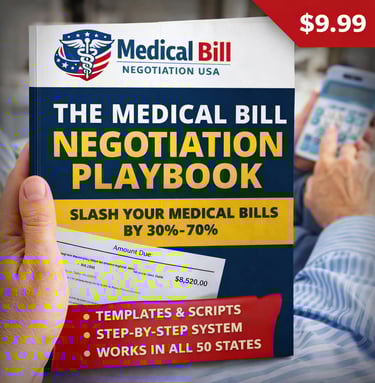
That’s exactly why the Medical Bill Negotiation Playbook exists.
It’s not motivation.
It’s not theory.
It’s not fluff.
It’s the full system:
Word-for-word scripts
Phone call flows
Letter templates
Settlement calculators
Timing strategies
Collections defense
Credit protection
And advanced negotiation tactics hospitals never explain
If a medical bill is hanging over your head right now—or if you want to make sure it never controls you again—this is the single most valuable resource you can have.
Because the next time a hospital sends you a bill, you won’t feel panic.
You’ll know exactly what to say, exactly when to say it, and exactly how far to push.
And that changes everything.
👉 Get the Medical Bill Negotiation Playbook now, before you say a single unnecessary word to billing—and lock in the knowledge that can save you thousands, not just once, but every time this system tries to overwhelm you.
The bill isn’t the final word.
What you say next is.
continue
…What you say next is.
And now we go deeper—into the exact phrases, psychological triggers, and advanced negotiation tactics that turn a routine billing call into a real financial win.
Everything up to this point prepares you to sound competent.
What follows is how you sound dangerous—in the quiet, professional way hospitals respect.
The Itemized Bill Trap (And How to Use It Against Them)
One of the most powerful things you can say—especially early—is this:
“Before we discuss payment, I’d like a fully itemized bill for this account, including CPT codes.”
This does not mean:
You plan to audit every line (though you can)
You are accusing them of fraud
You are delaying irresponsibly
What it does mean:
The bill is no longer passive
Someone has to do work
The account slows down
Hospitals know that itemized bills:
Expose duplicate charges
Reveal inflated line items
Create negotiation pressure
If they say the bill is already itemized:
“This statement isn’t sufficiently detailed for me to understand or verify the charges. I need the full itemized version.”
Once you request this, the clock resets.
And here’s the leverage most people miss:
You do not negotiate until after you receive it.
Why?
Because:
Errors appear
Charges mysteriously disappear
Totals quietly shrink
Then—and only then—you negotiate.
What to Say When You Spot a Questionable Charge
You don’t accuse.
You inquire.
“Can you explain what this charge represents and why it was billed at this rate?”
Then stop talking.
If the explanation is vague:
“Is this standard for all patients, or is it specific to my case?”
That question alone often triggers:
Internal review
Reclassification
Silent adjustments
If they can’t explain it clearly, that charge is weak.
Weak charges disappear.
The “Comparable Rates” Power Move
Hospitals hate comparisons.
Use them anyway.
Say:
“I’ve been researching typical rates for this procedure, and this charge appears significantly higher than average. How was this rate determined?”
You are not citing sources.
You are not debating medicine.
You are questioning pricing logic.
Billing departments are allergic to logic.
If they say, “Those are our rates”:
“I understand. I’m asking how those rates translate into what patients actually pay.”
That distinction matters.
Sticker price is not payment price.
The Charity Care Door (Even If You Think You Don’t Qualify)
Most hospitals—especially non-profits—have charity care programs.
Many patients qualify without realizing it.
Say this explicitly:
“I’d like to be screened for charity care or financial assistance under your hospital’s policy.”
Do not say “if I qualify.”
Say “screened.”
If they resist:
“I understand. I’d still like to complete the screening process.”
Hospitals are required to offer this.
And here’s the secret:
Partial assistance still counts.
Even a small qualification can:
Reduce balances
Trigger write-offs
Unlock further negotiation
What to Say If They Ask for Income Documentation
This scares people.
It shouldn’t.
You can say:
“I’m happy to provide documentation if needed. Before doing that, can you tell me what ranges typically qualify for assistance?”
This accomplishes two things:
You learn thresholds
You avoid oversharing prematurely
If they insist:
“I’ll review the request and submit what’s appropriate.”
You are still in control.
The “Hardship Letter” That Actually Works
Sometimes you’re asked to submit a written explanation.
Most people ramble.
Don’t.
Use this structure:
One paragraph
Neutral tone
Focus on impact, not emotion
Example language:
“Due to my current financial situation, paying the full balance on this account would cause significant financial hardship. After essential living expenses, I do not have sufficient resources to cover this bill as billed. I am requesting a review for financial assistance or an adjusted balance that reflects my ability to pay.”
That’s it.
No drama.
No sob story.
No unnecessary detail.
Professional.
Unavoidable.
Timing Your Calls for Maximum Leverage
This matters more than people realize.
Best times to call:
Mid-week (Tuesday–Thursday)
Mid-morning or early afternoon
Toward the end of the month or quarter
Why?
Fewer supervisors off
Lower call volume
More pressure to close accounts
Worst times:
Mondays
Fridays
Early mornings
Right after holidays
You want calm, bored, resolution-focused staff—not stressed ones.
When to Let Silence Do the Work
After you make a request, stop talking.
Silence feels uncomfortable.
That’s why it works.
Billing reps are trained to fill silence—with concessions.
Let them.
The “We’ve Never Done That Before” Response
You will hear this.
Your reply:
“I understand. Can you check whether an exception is possible in this case?”
Exceptions are the backbone of hospital billing.
Policies are guidelines.
Money is flexible.
The Escalation Ladder (Use It Strategically)
If you hit a wall, escalate in this order:
Billing representative
Supervisor
Financial assistance office
Patient advocate
Hospital administration
Each step increases:
Authority
Discretion
Desire to resolve
Always stay calm.
Always sound reasonable.
Always frame requests as resolution-oriented.
What to Say If They Threaten Collections
Do not panic.
Say:
“I’m actively trying to resolve this account and have been in communication. I’m requesting that collections activity be paused while we work through this.”
Then ask:
“Can you note that in the account?”
Notes matter.
Documentation matters.
The Credit Score Fear (And the Truth)
Medical debt is treated differently than other debt.
And once paid or settled:
It can often be removed
Or loses impact
But here’s the leverage point:
Hospitals would rather:
Discount
Settle
Write off
Than:
Chase
Damage goodwill
Absorb collection fees
Use that knowledge quietly.https://medicalbillnegotiationusa.com/medical-bill-negotiation-playbook
Advanced Move: The “Single-Case Review” Request
This sounds intimidating. It’s not.
Say:
“Given the circumstances, I’m requesting a single-case review for this account.”
That phrase signals:
Escalation
Documentation
Decision-making beyond scripts
It slows the process—and slows benefit patients.
Slower = leverage.
When Negotiations Stall (And How to Restart Them)
If nothing moves, pause.
Wait 30 days.
Then call back and say:
“I’m following up to see if there’s been any change in flexibility on this account.”
Different rep.
Different mood.
Different outcome.
This is normal.
Why Persistence Beats Aggression Every Time
Aggression triggers defense.
Persistence triggers resolution.
Hospitals expect:
Angry people
Passive people
They do not expect:
Calm, informed, persistent negotiators
Be the third.
Another Real Example: $8,400 Reduced to $1,700
Patient with insurance. High deductible.
Steps used:
Requested itemized bill
Asked for self-pay equivalent
Claimed hardship
Offered lump sum
Final result:
80% reduction
Account closed
No collections
The difference wasn’t luck.
It was language.
The Emotional Weight You’re Carrying Is Part of the System
Medical bills don’t just cost money.
They cost:
Sleep
Focus
Confidence
Peace
The system counts on your silence.
Every call you make breaks that pattern.
You Are Not Asking for a Favor
This is critical.
You are:
Negotiating a financial account
Requesting policy-based adjustments
Seeking resolution
That mindset changes everything.
When to Stop Negotiating and Lock the Deal
Once you reach a number you can live with:
“If I make this payment, will the account be considered paid in full?”
Get a yes.
Then:
“Can you provide written confirmation before I submit payment?”
Never skip this step.
Never.
Why This Skill Pays Off for Life
Medical bills don’t happen once.
They happen:
After emergencies
After surgeries
After accidents
After diagnoses
Knowing what to say is not a one-time win.
It’s lifetime leverage.
The Truth Most Hospitals Won’t Admit
They expect negotiation.
They budget for discounts.
They rely on most people not knowing how to ask.
Now you do.
And This Is Only the Surface
What you’ve learned here already puts you ahead of 90% of patients.
But there’s more:
Exact scripts for every scenario
What to say when insurance denies claims
How to appeal decisions
How to handle surprise billing
How to protect your credit
How to negotiate after payment
How to recover overpayments
How to handle balance billing
How to deal with out-of-network traps
That’s why the Medical Bill Negotiation Playbook exists.
Not as advice.
As a system.
It’s the difference between hoping the bill shrinks—and making sure it does.
If you’re facing a bill right now, time matters.
If you want to never feel powerless again, preparation matters.
👉 Get the Medical Bill Negotiation Playbook and take control before the system decides for you.
Because hospitals know how this works.
Now you do too.
And that’s where the power shifts…
continue
…that’s where the power shifts.
But there’s still a deeper layer most people never reach—the layer where hospital billing stops treating you like a “patient with a problem” and starts treating you like an account that must be resolved.
That layer is accessed through precision language, sequence, and controlled pressure.
Let’s keep going.
The “Resolution Framing” That Forces Movement
Hospitals are slow when accounts feel open-ended.
They move fast when they sense closure.
That’s why this sentence is so powerful:
“I’m calling to determine the best way to resolve this account today.”
This does not mean you will pay today.
It means you are focused on resolution, not discussion.
Resolution language triggers:
Supervisor involvement
Policy review
Settlement authority
If they respond with vague options, bring it back:
“Which of these options actually resolves the account in full?”
You are subtly removing everything except a discount or settlement from the table.
The “Internal Notes” Strategy (Quiet but Deadly)
Every billing system has internal notes.
You want the right ones added.
Say this:
“Can you note on the account that I’m requesting a hardship review and exploring resolution options?”
Why this matters:
Future reps see it
Supervisors see it
Collections sees it
Accounts with notes are treated differently than silent ones.
Silence = neglect
Notes = process
Always choose process.
What to Say When They Ask: “How Much Can You Pay?”
This question is a trap if answered emotionally.
Never say:
“As much as possible”
“I’ll try”
“Whatever I can”
Instead say:
“That depends entirely on what the adjusted balance would be after any assistance or discounts.”
This keeps:
The burden on them
The number flexible
Your leverage intact
If they insist:
“I don’t want to misrepresent my ability before seeing what adjustments are available.”
That sounds responsible—not evasive.
The “Conditional Commitment” Technique
This is one of the most effective negotiation tools.
Structure your language like this:
“If the balance can be reduced to a level that reflects my situation, I’m committed to resolving it.”
You are offering:
Cooperation
Closure
Serious intent
Without offering:
A number
A concession
A deadline
This makes them work to earn your commitment.
When They Say “We Don’t Negotiate”
This is almost never true.
Respond calmly:
“I understand you may not call it negotiation. I’m asking about hardship adjustments, assistance programs, or settlement options that result in a resolved account.”
You are reframing without challenging.
If they still resist:
“Who would be the appropriate department to discuss that with?”
There is always an appropriate department.
The “Policy Request” That Opens Doors
Policies sound rigid.
But asking about them creates flexibility.
Say:
“Can you provide me with a copy or summary of your financial assistance and billing policies?”
Now the rep knows:
You’re informed
You’re persistent
You’re not going away
Policy awareness is leverage.
How to Handle High-Pressure Payment Demands
Sometimes a rep pushes urgency.
Stay grounded.
Say:
“I’m not refusing to pay. I’m requesting a fair resolution that reflects my situation. Rushing into an unaffordable payment doesn’t resolve the issue.”
This frames delay as responsibility—not avoidance.
The “Out-of-Network” Nuclear Option (Used Carefully)
If your bill involves out-of-network charges:
“I was not informed that this provider was out-of-network, and I’m requesting an adjustment consistent with in-network or no-surprise billing standards.”
Even when laws don’t fully apply, hospitals fear:
Complaints
Reviews
Regulatory attention
This often triggers internal review.
The “Medical Necessity” Angle (Underused and Powerful)
For certain charges, say:
“Can you confirm that all services billed were medically necessary and properly documented?”
This is not an accusation.
It signals:
Awareness
Willingness to question
Potential appeal
Billing departments don’t like appeals.
They like discounts.
What to Say If They Offer a Small Discount (But You Need More)
Don’t accept immediately.
Say:
“I appreciate that. Unfortunately, that still doesn’t make the balance manageable. Is there any additional flexibility?”
Then pause.
Often, “additional flexibility” appears.
The Second Counteroffer (Where Deals Are Made)
Negotiations rarely end on the first offer.
If they counter higher than you want:
“That’s closer, but still difficult. If we could bring it down a bit more, I could resolve it.”
Notice:
No numbers
No threats
No emotion
Just inevitability.
How to Lock In a Settlement Without Regret
Once you agree on a number:
“To confirm, this payment will satisfy the account in full, and no further balance will be owed or reported?”
Wait for confirmation.
Then:
“Please send that confirmation in writing before payment.”
If they hesitate, do not pay.
Why Paying Immediately Can Be a Mistake
Even after agreement, you can say:
“Once I receive the written confirmation, I’ll review and proceed.”
This gives you:
Time
Protection
Leverage if terms change
Never rush payment.
Resolution is not urgency-driven.
The After-Payment Check (Most People Skip This)
After paying:
Save confirmation
Check credit reports
Follow up in 30 days
If anything remains:
“This account was settled. I’m calling to ensure it’s properly closed.”
Clean closure matters.
The Psychological Shift That Makes This All Easier
You are not negotiating care.
You are negotiating accounting.
Hospitals separate:
Clinical teams
Financial teams
Billing is transactional.
Treat it that way.
Why Hospitals Fold More Often Than You Think
Because:
They expect non-payment
They budget for write-offs
They prefer certainty
They want accounts closed
You are offering certainty—on your terms.
One More Real Case: $52,000 → $6,200
Uninsured patient. Surgery.
Steps:
Self-pay request
Charity screening
Itemized review
Lump-sum offer
Final:
88% reduction
Paid in full
No collections
This happens every day.
Quietly.
The Cost of Not Negotiating
People who don’t negotiate:
Drain savings
Use credit cards
Skip necessities
Carry shame
None of that is required.
The system is negotiable by design.
You Don’t Need Confidence—You Need Scripts
Confidence grows after results.
Scripts create results.
That’s why professionals rely on:
Exact wording
Proven sequences
Tested responses
Not improvisation.
This Is the Difference Between Hoping and Controlling
Hope sounds like:
“Maybe they’ll help.”
Control sounds like:
“I know how to move this account.”
You now know.
And Still—This Is Only Part of the System
We haven’t even touched:
Post-insurance denials
Retroactive self-pay
Balance billing disputes
Emergency room leverage
Provider-side negotiations
Physician group bills
Facility vs professional fees
Duplicate billing across departments
Coding errors that erase thousands
Appeals that trigger write-downs
Strategic non-payment windows
All of that lives inside the Medical Bill Negotiation Playbook.
Not scattered advice.
A full map.
If you’re dealing with a bill right now, every word you say matters.
If you want to stop guessing and start controlling outcomes, this is the moment.
👉 Get the Medical Bill Negotiation Playbook and walk into your next billing call knowing exactly what to say, exactly when to say it, and exactly how to protect yourself from overpaying ever again.
Because hospitals already know this game.
Now you’re finally playing it too.
And once you play it once, you’ll never go back to silence again…
Help
Lower your medical bills with expert support
Contact
infoebookusa@aol.com
© 2026. All rights reserved.