Overcharged by a Hospital? Here’s What to Do Right Now
Blog post description.
7/30/202611 min read

Overcharged by a Hospital? Here’s What to Do Right Now
If you are reading this, there is a high chance you are under real financial stress. You may be staring at a hospital bill that feels wrong, inflated, confusing, or flat-out impossible to pay. Maybe it arrived weeks after care you barely remember. Maybe the numbers don’t match what anyone told you. Maybe insurance “paid something,” but you are still left with a balance that could derail your savings, your credit, or your peace of mind.
In many cases we see, the emotional impact of a hospital bill is as severe as the medical issue itself. People describe panic, anger, shame, and paralysis. Bills trigger fear responses. That matters, because hospital billing systems quietly rely on that emotional overload. Confused patients are easier to collect from. Overwhelmed patients miss deadlines. Scared patients pay bills they do not actually owe.
This article is written to stop that spiral.
Not with vague tips. Not with recycled internet advice. And not with legal jargon. What follows is a practical, real-world guide based on patterns that repeat across hospital billing departments and across thousands of patient situations. The focus is judgment, sequencing, and timing—what to do right now, what to delay, and what not to do even though it feels urgent.
You do not need to be aggressive. You do not need to threaten anyone. You do not need to understand medical coding on day one. But you do need to slow the process down, regain control, and make the hospital justify the numbers they sent you.
Let’s start with the most important truth.https://medicalbillnegotiationusa.com/medical-bill-negotiation-playbook
The Most Important Thing to Understand Immediately
A hospital bill is not a final judgment.
It is a starting document.
In practice, this often happens when hospitals auto-generate patient balances before reconciliation is complete. Charges post. Insurance processing lags. Adjustments are pending. Charity policies are not applied. Discounts are not triggered. And the patient receives a “statement” that feels official but is, in reality, provisional.
One pattern that repeats across medical billing situations is this:
Patients treat the first bill as a verdict. Hospitals treat it as an opening position.
You should do the same.
What to Do in the First 24–72 Hours After Receiving the Bill
Step 1: Do Not Pay Anything Yet (Even If You Can)
This is counterintuitive, especially if you are responsible and debt-averse.
But in many cases we see, early payment eliminates leverage and freezes errors in place. Once money is applied, internal billing incentives shift from “fix” to “close.” Refunds are possible, but they are slow and difficult.
Paying nothing is not the same as ignoring the bill.
You are not refusing. You are pausing.
Step 2: Create a Simple Case File (This Matters More Than People Think)
Before you call anyone, create a folder—digital or physical—and put everything related to this visit inside it.
Include:
The hospital bill (every page)
Any explanation of benefits (EOB) from insurance
Appointment confirmations or discharge paperwork
Notes you remember about what actually happened
Dates, names, and departments if you have them
In practice, patients who stay organized are treated differently by billing departments. You do not need to announce this. It shows in how you ask questions.
Step 3: Look for the Three Red Flags We See Most Often
Do not analyze the whole bill yet. Just scan for these:
Services You Don’t Recognize
Tests, scans, supplies, or “levels” of care you do not recall.Out-of-Network Surprises
Especially common with ER visits, anesthesiology, radiology, or labs.Balances That Ignore Insurance Rules
Deductibles, copays, or coinsurance that seem mathematically wrong.
If you see even one of these, you are not dealing with a “normal” bill.
Why Hospital Bills Are So Often Wrong
This matters, because self-blame is common. Patients assume they “just don’t understand.”
In reality, hospital billing errors are systemic.
Fragmented Systems Create Fragmented Bills
Hospitals are not one billing entity. They are a collection of departments, contractors, and third parties all charging under one visit.
In many cases we see:
The hospital facility bills separately
Physicians bill separately
Anesthesia bills separately
Labs bill weeks later
Emergency physicians bill from outside groups
Each system has its own incentives, software, and error rates.
Billing Is Automated Long Before It Is Accurate
One pattern that repeats across hospital billing departments is the use of automated charge posting before human review. Codes are generated based on documentation, not on patient understanding or fairness.
The first bill reflects what the system can charge—not what it should collect.
Patients Are the Last Line of Quality Control
This is uncomfortable but true. Hospitals rely on patients to catch errors because internal review is expensive and slow.
When a patient challenges a bill clearly and calmly, errors surface that would otherwise stand.
The Single Most Powerful Tool You Have: The Itemized Bill
Why You Must Ask for It (Every Time)
An itemized bill is not the same as a statement. It breaks charges into individual line items with codes, dates, and prices.
In practice, requesting an itemized bill does three things immediately:
It slows the collection process
It triggers internal review
It exposes inconsistencies
Many billing offices will not volunteer this document. You must ask.
How to Request It Without Triggering Pushback
You do not need to argue. Use neutral language.
A simple script that works in many cases:
“I need a fully itemized bill for this visit so I can understand and review the charges before discussing payment.”
Do not mention negotiation yet. Do not mention hardship yet.
You are gathering information.
What We See Most Often When Patients Review Itemized Bills
Once itemized bills arrive, patterns emerge:
Duplicate charges for the same service
“Unbundled” charges that should be grouped
Supplies billed at extreme markups
Higher-level service codes than the visit warrants
Charges dated for days you were not there
You do not need to identify all of these. Identifying one is often enough to reopen the entire account.
What Not to Say (Even Though It Feels Natural)
Avoid These Phrases Early On
“I can’t afford this”
“This is ridiculous”
“I’m not paying”
“This is a scam”
In many cases we see, these statements trigger defensive scripts rather than solutions.
Early conversations should be about accuracy, not ability to pay.
There will be a time to discuss hardship. That time is later.
How Insurance Complicates (and Sometimes Helps) the Situation
Understanding the EOB Without Becoming an Expert
An Explanation of Benefits is not a bill. It is a processing document.
In practice, this often happens when insurance applies contractual adjustments that the hospital has not yet reflected on the patient statement.
Key things to look for:
Amount billed vs. allowed amount
Adjustments or write-offs
Patient responsibility calculation
If the hospital bill does not match the EOB, that is not your problem to reconcile—it is theirs.
When Insurance Is Wrong Too
One pattern that repeats across medical billing situations is misapplied patient responsibility. Deductibles applied twice. Copays ignored. Coinsurance miscalculated.
You are allowed to challenge insurance determinations. Hospitals expect this. They just hope you won’t.
Timing Matters More Than Aggression
Why Waiting a Few Weeks Can Help
This sounds risky, but in many cases we see, hospitals continue internal adjustments for 30–90 days after service.https://medicalbillnegotiationusa.com/medical-bill-negotiation-playbook
Paying or escalating too early can lock in preliminary numbers.
As long as you are communicating and requesting documentation, accounts are usually flagged as “under review,” which pauses escalation.
Collection Threats Are Often Automated
Early collection notices are often system-generated. They feel urgent, but they do not mean immediate damage.
What matters is documented engagement.
Common Mistakes Patients Make at This Stage
Mistake #1: Setting Up a Payment Plan Too Early
Payment plans feel like relief. They are not.
Once a plan is active, negotiation leverage drops sharply. The balance is treated as accepted.
Mistake #2: Focusing on Monthly Payment Instead of Total Balance
Hospitals love to talk monthly numbers. Patients should talk total liability.
A manageable monthly payment on an incorrect or inflated balance is still a loss.
Mistake #3: Explaining Too Much Emotionally
You do not need to justify your stress. Stick to facts and questions.
The Moment to Shift From Review to Negotiation
Once:
You have an itemized bill
Insurance adjustments are finalized or disputed
Errors are identified or suspected
Then—and only then—it is time to discuss reduction, assistance, or settlement.
In practice, this often happens 30–90 days after the first bill, not immediately.
Patterns That Repeat Across Hospital Billing Departments
Pattern 1: The First “No” Is Automatic
Initial requests for reduction are often denied by frontline staff. This is procedural, not personal.
Persistence matters.
Pattern 2: Different Departments Have Different Authority
Customer service, billing, financial assistance, and supervisors all operate under different rules.
Knowing who to talk to matters as much as what you say.
Pattern 3: Silence Is Interpreted as Acceptance
If you stop communicating, the system escalates.
If you communicate calmly and consistently, accounts slow down.
A Simple Decision Path to Keep You Oriented
Use this mental framework:
Is the bill accurate?
If no → dispute and reviewIs insurance applied correctly?
If no → insurance appealIs the balance still unaffordable?
If yes → assistance or negotiation
Do not skip steps.
When Hospitals Are Most Willing to Negotiate
In many cases we see, hospitals are most flexible when:
The balance is large
Payment has not started
The account is aging but not in collections
The patient is organized and consistent
There is documented financial strain
This is about timing, not pleading.
What “Negotiation” Really Means in Medical Billing
Negotiation is not haggling.
It is the structured reduction of a balance based on:
Errors
Policy
Financial assistance thresholds
Prompt-pay discounts
Settlement authority
Hospitals rarely advertise these levers. But they exist.
The Role of Financial Assistance (Even If You Think You Don’t Qualify)
One pattern that repeats across hospital billing situations is underuse of assistance programs.
Patients assume:
Income is too high
Assets disqualify them
Insurance means no help
In practice, assistance policies are broader than people think, and partial reductions are common.
Applying does not obligate you to accept the result. But it creates a paper trail that helps negotiation.
What to Do If the Bill Is Already in Collections
This deserves its own deep discussion, but one key point matters now:
Collections do not eliminate errors or negotiation.
In many cases we see, balances are reduced or resolved even after transfer—especially if the underlying charges are flawed.
Do not panic. The process changes, but it does not end.
The Emotional Side: Why This Feels So Overwhelming
Medical bills hit people when they are vulnerable.
Illness, injury, fear, and financial uncertainty overlap. Hospitals know this, even if no individual employee intends harm.
One pattern that repeats across patient stories is delayed action—not because of irresponsibility, but because of emotional overload.
Clarity reduces fear. Structure restores control.
That is what you are doing now.
How This Process Usually Ends (Realistically)
In practice, outcomes fall into a few categories:
Errors corrected → balance reduced significantly
Insurance reapplied → patient responsibility lowered
Assistance granted → partial or full reduction
Negotiated settlement → lump-sum discount
Manageable plan → only after balance is verified
Very rarely does the original number stand untouched when properly challenged.
Why Doing This Alone Is Harder Than It Looks
Medical billing systems are not designed for patient clarity. They are designed for throughput.
Many people we see are capable, intelligent, and organized—yet still overwhelmed by the sequencing, timing, and scripts required.
It is not about intelligence. It is about experience.
A Final Word Before You Take the Next Step
You do not need to fight. You do not need to rush. And you do not need to accept a number you do not understand.
You need:
A clear process
The right order of actions
Language that keeps doors open
And confidence that this is fixable
Take Back Control With the Medical Bill Negotiation Playbook
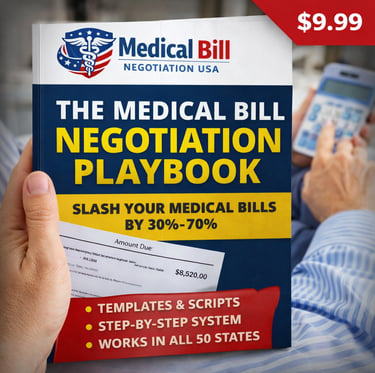
If you want a step-by-step, calm, structured guide that walks you through exactly how to review, dispute, negotiate, and resolve hospital bills—without threats, hype, or false promises—the Medical Bill Negotiation Playbook was created for this moment.
It is designed for people under real financial pressure who want clarity, not sales tactics. It focuses on decision paths, timing, scripts that work in practice, and how to avoid the mistakes that quietly cost patients thousands.
No guarantees. No gimmicks. Just a clear way forward.
When you are ready to stop guessing and start acting with confidence, the next step is there.
https://medicalbillnegotiationusa.com/medical-bill-negotiation-playbook
What We See Most Often in Real Negotiations
After assisting and observing many hospital billing disputes, one thing becomes very clear: most negotiations do not hinge on clever arguments. They hinge on timing, persistence, and understanding how hospital billing departments actually operate day to day.
Patients often imagine negotiation as a dramatic confrontation. In practice, it is usually a slow, procedural process where small, correctly timed actions compound into large reductions.
Pattern #1: Bills Shrink in Stages, Not All at Once
In many cases we see, patients expect a single conversation to “fix” everything. That almost never happens.
Instead, balances change incrementally:
First adjustment after itemization review
Second adjustment after insurance reprocessing
Third adjustment after internal audit or supervisor review
Final reduction after financial assistance or settlement discussion
This is why patience matters. Hospitals rarely give away their maximum flexibility upfront.
Pattern #2: The Best Outcomes Come From Boring, Consistent Follow-Up
The patients who get the best results are not the loudest or most aggressive. They are the most consistent.
They:
Call back when promised
Reference prior conversations accurately
Keep notes
Use neutral, professional language
Ask the same questions repeatedly until answered
In practice, this builds credibility. Billing staff begin to see the account as “high effort,” which increases internal motivation to resolve it cleanly.
Pattern #3: Negotiation Authority Is Tiered
Frontline representatives often cannot approve meaningful reductions. Their job is to:
Explain the bill
Offer payment plans
Route assistance applications
Actual reductions usually come from:
Supervisors
Billing managers
Financial assistance departments
Resolution teams handling aging accounts
Knowing this prevents frustration. A “no” from the first person you speak to is not a conclusion—it is a procedural step.
The Right Way to Escalate (Without Burning Bridges)
Escalation is not about threats. It is about appropriate routing.
When to Escalate
Escalation makes sense when:
Errors remain unresolved after documentation
Insurance discrepancies persist
You receive conflicting explanations
The account is aging without progress
Escalating too early can stall the process. Escalating too late can reduce leverage.
How to Escalate Effectively
Use language that signals seriousness without hostility:
“I’ve been working on resolving this for several weeks, and I’m not making progress. I’d like to speak with someone who can review the account more comprehensively.”
This frames escalation as efficiency, not complaint.
Common Mistakes Patients Make During Negotiation
Mistake #4: Accepting Verbal Promises Without Documentation
In practice, verbal assurances disappear.
If someone says:
“That will be adjusted”
“You won’t owe that”
“It should update soon”
Ask:
“Can you note that on the account or send written confirmation?”
If it is not documented, assume it may not happen.
Mistake #5: Missing Financial Assistance Windows
Many hospitals have time-bound assistance policies. Waiting too long can close doors.
Even if you think you won’t qualify, submitting an application can:
Pause collections
Trigger manual review
Lead to partial reductions
Assistance is not charity. It is part of hospital compliance and revenue strategy.
Mistake #6: Letting Accounts Age in Silence
Silence is interpreted as acceptance.
Even a short call every 30–45 days can prevent escalation while keeping negotiation options open.
Understanding Hospital Financial Assistance Policies (The Part No One Explains)
Why Hospitals Rarely Volunteer This Information
Assistance programs reduce revenue. Hospitals are required to have them, but not to promote them aggressively.
In many cases we see, patients qualify for reductions they never knew existed.
What Assistance Can Look Like in Practice
Assistance is not always “free care.” More commonly, it includes:
Percentage reductions
Sliding-scale discounts
Reclassification of balances
Removal of certain categories of charges
Even partial assistance can dramatically change a negotiation outcome.
Documentation Matters More Than Income Alone
Policies often consider:
Income relative to household size
Recent financial hardship
Medical debt burden
Temporary disruptions (job loss, illness)
Providing context matters, but keep it factual and concise.
How Settlement Negotiations Actually Work
Settlement usually happens after other levers are exhausted.
What Settlement Is (and Isn’t)
Settlement is:
A one-time lump-sum payment
In exchange for closing the account
Often at a discounted amount
Settlement is not:
A payment plan
A guarantee
An admission of fault
When Hospitals Are Most Open to Settlement
In practice, settlement becomes viable when:
The account is several months old
No payments have been made
Errors or disputes exist
The hospital wants closure
Hospitals prefer certainty over prolonged follow-up.
Why Cash Offers Matter
Offering a realistic lump sum signals seriousness.
You are not asking for mercy. You are offering resolution.
If the Bill Is Causing Immediate Financial Crisis
Some readers are not dealing with “stress.” They are dealing with imminent damage.
Rent at risk. Credit cards maxed. Savings gone.
If that is you, prioritize containment:
Communicate with billing to pause escalation
Request hardship review immediately
Avoid putting medical debt on high-interest credit unless absolutely necessary
Medical debt behaves differently from other debt. Treat it accordingly.
Patterns That Repeat Across Hospital Billing Departments (Again and Again)
Pattern: Confusion Works in Their Favor
Complexity discourages follow-up. Simplicity empowers patients.
Break the problem into steps.
Pattern: Systems Assume Passive Patients
Active patients disrupt default workflows.
Pattern: Time Creates Leverage—If Used Correctly
Rushing helps hospitals. Controlled pacing helps patients.
What Success Actually Looks Like (Realistically)
Success is not always zero balance.
Success is:
Paying what is fair
Avoiding unnecessary financial damage
Understanding what you owe and why
Ending the process with closure, not confusion
In many cases we see, patients save hundreds or thousands simply by not accepting the first number.
Why a Structured Playbook Makes a Difference
Medical billing negotiation is not intuitive.
It is a system with:
Unspoken rules
Hidden levers
Timing windows
Language that matters
Most people are navigating it for the first time, under stress.
A structured approach removes guesswork.
Final Guidance Before You Act
Slow down.
Document everything.
Ask for clarity before offering money.
Do not confuse urgency with obligation.
You have more control than the bill suggests.
Take the Next Step With Confidence
If you want a clear, practical roadmap that shows you exactly how to handle each stage—review, dispute, escalation, assistance, and settlement—the Medical Bill Negotiation Playbook exists for this reason.
It is built around real patterns, not theory. It helps you decide what to do now, what to delay, and what to avoid so you don’t accidentally lock yourself into a bad outcome.
No hype. No guarantees. Just clarity, structure, and control when you need it most.
When you’re ready to move forward without guessing, the path is there.
Help
Lower your medical bills with expert support
Contact
infoebookusa@aol.com
© 2026. All rights reserved.