No Surprises Act Explained for Patients (And How to Use It)
Blog post description.
2/27/202617 min read

No Surprises Act Explained for Patients (And How to Use It)
If you have ever opened a medical bill and felt your stomach drop—because the number staring back at you made absolutely no sense—you are not alone. Millions of Americans each year receive medical bills that are confusing, inflated, contradictory, or flat-out wrong. For decades, the healthcare system allowed patients to be blindsided by charges they never agreed to, from doctors they never chose, for services they never fully understood. That era is officially over.
The No Surprises Act is one of the most powerful patient-protection laws ever passed in the United States. Yet most patients have no idea how it works, when it applies, or—most importantly—how to use it to reduce or eliminate unfair medical bills.
This article is not a surface-level overview. It is a deep, practical, patient-first explanation of the No Surprises Act, written so you can actually apply it in real life. We will walk through real scenarios, common traps hospitals still use, the exact language you can rely on, and how to turn this law into leverage when negotiating medical bills.
If you are dealing with a large bill right now—or worried you might in the future—this may be one of the most financially important things you ever read.https://medicalbillnegotiationusa.com/medical-bill-negotiation-playbook
Why Surprise Medical Bills Were Such a Massive Problem
Before understanding the No Surprises Act, you need to understand the problem it was designed to fix.
For years, patients did “everything right”:
They went to an in-network hospital.
They confirmed their insurance coverage.
They followed their doctor’s instructions.
They paid their copays and deductibles.
And then weeks or months later, a bill arrived for thousands—or tens of thousands—of dollars.
Why?
Because one provider involved in their care was “out-of-network.”
That provider could be:
The emergency room physician
The anesthesiologist
The radiologist
The pathologist
A surgical assistant
A consulting specialist you never met
You had no control over these providers. You didn’t choose them. In many cases, you didn’t even know they existed. But under the old system, they could bill you directly for the difference between what your insurance paid and what they wanted to charge. This was called balance billing, and it devastated families financially.
People delayed care out of fear. Others drained savings, maxed out credit cards, or faced collections for bills they never consented to.
The No Surprises Act exists because this system was fundamentally unfair.
What the No Surprises Act Is (In Plain English)
The No Surprises Act is a federal law that protects patients from unexpected medical bills in specific situations.
At its core, the law says this:
If you receive certain types of medical care without a meaningful choice of provider, you cannot be charged more than in-network cost-sharing—even if the provider is out-of-network.
That’s it. That’s the heart of the law.
The insurance company and the provider can argue about payment behind the scenes. You are removed from the fight.
This law:
Applies nationwide
Applies to most private insurance plans
Applies regardless of your state
Applies whether or not you knew about it at the time of care
It does not require you to do anything in advance. Your protection exists automatically. You only need to assert it after you receive a bill.
When the No Surprises Act Applies
Understanding when the law applies is critical, because this is where hospitals and billing departments try to confuse patients.
The No Surprises Act covers three main situations.
1. Emergency Services (The Strongest Protection)
If you receive emergency care, the No Surprises Act almost always applies.
This includes:
Emergency room visits
Ambulance services (air and ground)
Emergency stabilization services
It does not matter:
Whether the hospital is in-network
Whether the doctor is in-network
Whether you had time to check coverage
Whether you signed forms at intake
If it was an emergency, you cannot be balance billed.
Real-World Example
You are rushed to the ER with severe chest pain. The hospital is in-network. Later, you receive a $6,400 bill from the ER physician group, claiming they are out-of-network.
Under the No Surprises Act:
That bill is illegal
You owe only your normal in-network copay or deductible
The rest is between the provider and your insurer
You do not negotiate this bill. You dispute it.
2. Non-Emergency Care at In-Network Facilities
This is where many of the most abusive surprise bills used to happen.
If you receive non-emergency care at an in-network hospital or surgical center, the No Surprises Act protects you from surprise out-of-network charges from ancillary providers.
Ancillary providers include:
Anesthesiologists
Radiologists
Pathologists
Neonatologists
Assistant surgeons
Hospitalists
In other words, the people you didn’t choose.
Real-World Example
You schedule an in-network surgery at an in-network hospital. Weeks later, you get a $9,200 bill from an anesthesiology group you never met.
Before the law, this was common.
After the law, this is illegal.
You cannot be charged more than in-network cost sharing.
3. Air Ambulance Services
Air ambulance bills were among the most extreme—often exceeding $30,000.
The No Surprises Act:
Covers air ambulance services
Prohibits balance billing
Applies even if the provider is out-of-network
Ground ambulances are more complicated (and still a problem), but air ambulances are clearly covered.
When the No Surprises Act Does Not Apply
This is just as important as knowing when it does apply.
The No Surprises Act does not protect you if:
You voluntarily choose an out-of-network provider
You sign a valid Notice and Consent form
You receive care that is explicitly excluded
However, the rules for valid consent are extremely strict, and most “consent” hospitals claim is not legally valid.
We will break that down in detail later—because this is one of the most powerful ways patients win disputes.
The Good Faith Estimate (GFE): Your Second Line of Defense
One of the most overlooked parts of the No Surprises Act is the Good Faith Estimate.
If you are uninsured or self-pay—or even insured but choosing not to use insurance—providers must give you a written estimate of expected charges before care.
This estimate must:
Be provided in advance
Include all reasonably expected charges
Be accurate within a specific margin
If your final bill is $400 or more above the estimate, you have the right to dispute it through a federal process.
This is not optional for providers. This is the law.
The “Notice and Consent” Trap (And How to Spot It)
Hospitals didn’t just give up surprise billing quietly. They adapted.
One of their main strategies is the Notice and Consent form.
This is a document that supposedly allows you to waive your No Surprises Act protections and agree to out-of-network charges.
But here’s the truth:
Most Notice and Consent forms are invalid.
For consent to be valid, it must:
Be provided at least 72 hours in advance (or same day for certain services)
Clearly state that the provider is out-of-network
Provide a good faith estimate of costs
Give you a meaningful opportunity to choose an in-network alternative
Be specific to the service—not a blanket waiver
A form buried in a stack of intake paperwork does not count.
A form signed under pressure does not count.
A form without a real cost estimate does not count.
If a hospital claims you “consented,” the burden is on them to prove it.
What to Do When You Receive a Surprise Medical Bill
This is where most patients panic—and where mistakes happen.
Do not pay the bill.
Do not set up a payment plan.
Do not assume the hospital is right.
Instead, follow this exact process.https://medicalbillnegotiationusa.com/medical-bill-negotiation-playbook
Step 1: Identify the Type of Bill
Ask yourself:
Was this emergency care?
Was this care at an in-network facility?
Was the provider out-of-network?
Did I knowingly choose them?
If the answer fits any protected category, the No Surprises Act likely applies.
Step 2: Request an Itemized Bill
Always request an itemized bill in writing.
This:
Exposes errors
Slows down collections
Creates a paper trail
Forces billing departments to re-review the account
Many “surprise” bills collapse at this stage alone.
Step 3: Dispute the Bill in Writing
Use clear, firm language. Do not argue emotionally. Cite the law.
Example language:
“This bill appears to violate the No Surprises Act. The services were provided at an in-network facility, and I did not consent to out-of-network care. Please reprocess this claim as in-network and issue a corrected statement.”
You are not asking.
You are asserting a legal right.
Step 4: Contact Your Insurance Company
Tell them explicitly:
You are disputing a No Surprises Act violation
You want the claim reprocessed
You want confirmation in writing
Insurance companies are legally required to comply.
Step 5: File a Federal Complaint if Needed
If the provider refuses to correct the bill, you can file a complaint with the federal government.
This is free.
It is powerful.
And providers take it seriously.
Many bills disappear once a complaint is filed.
How the No Surprises Act Changes Medical Bill Negotiation
Here is the key insight most people miss:
The No Surprises Act gives you leverage.
Even when a bill is not 100% covered by the law, hospitals know:
Regulators are watching
Complaints are increasing
Billing practices are under scrutiny
This changes how willing they are to negotiate.
If a bill is even borderline questionable, providers are more likely to:
Reduce charges
Write off balances
Settle for pennies on the dollar
Close the account quietly
This is why understanding the law—even when it doesn’t fully apply—can still save you thousands.
Emotional Reality: Why This Law Matters More Than You Think
Medical bills are not just financial. They are emotional.
They cause:
Anxiety
Shame
Fear
Avoidance
Sleepless nights
Relationship stress
Many people blame themselves:
“I should have asked more questions.”
“I shouldn’t have gone to that hospital.”
“I must have signed something wrong.”
The truth is simpler and harder:
The system was designed to confuse you.
The No Surprises Act shifts power back where it belongs—with the patient.
But only if you use it.
The Hidden Loopholes Hospitals Still Exploit
Even with the law in place, hospitals and billing companies continue to push boundaries. They rely on the same thing they always have: patient confusion, fear, and silence.
One common tactic is relabeling services to make them appear exempt. A bill might be described in vague terms, making it unclear whether the service was emergency, ancillary, or elective. Another tactic is delaying responses, hoping you’ll give up and pay just to make the stress stop.
Some providers send bills marked “patient responsibility” even when the insurer has not completed proper processing. Others claim the law “doesn’t apply” without explanation, counting on you not to challenge them.
This is why documentation matters. Every phone call should be followed by a written confirmation. Every claim should be reviewed. Every assertion should be backed by the language of the law.
When you stay calm, persistent, and informed, the dynamic changes. Billing departments are trained to push back—but they are also trained to retreat when faced with clear legal knowledge.
Using the No Surprises Act as a Negotiation Weapon
Here’s a critical mindset shift: disputing and negotiating are not the same thing, but they can work together.
If a bill clearly violates the No Surprises Act, you dispute it outright. You do not negotiate an illegal charge.
If a bill is questionable, ambiguous, or partially protected, you negotiate from a position of strength.
You can say:
“This appears to fall under the No Surprises Act.”
“I am prepared to file a federal complaint.”
“I am requesting a full review before escalating.”
These statements change the tone instantly.
Even when providers believe they are technically compliant, they often choose settlement over scrutiny.
What Happens Behind the Scenes (And Why It Helps You)
Under the No Surprises Act, providers and insurers must resolve payment disputes through an Independent Dispute Resolution (IDR) process. This process is expensive, time-consuming, and risky for providers.
They must:
Submit documentation
Justify their charges
Risk receiving less than they asked for
Pay administrative fees
Because of this, many providers prefer to:
Adjust the bill
Accept in-network rates
Write off balances
Close the account
You don’t see this process—but your willingness to assert your rights often determines whether it ever happens.
The Biggest Mistake Patients Still Make
The single biggest mistake patients make is paying too soon.
Once you pay—even partially—you weaken your position. Some protections become harder to enforce. Negotiation leverage disappears.
Always pause.
Always review.
Always question.
Time is almost always on the patient’s side, not the provider’s.
Why Knowledge Alone Is Not Enough
Understanding the No Surprises Act is powerful—but applying it consistently, confidently, and strategically is something else entirely.
Medical billing systems are complex by design. They use specialized language, opaque codes, and intimidating processes. Most people are dealing with these bills while sick, exhausted, or emotionally overwhelmed.
That’s why having a step-by-step playbook matters.
Your Next Move: Take Control of Your Medical Bills
If you are serious about:
Reducing medical bills
Challenging unfair charges
Negotiating from a position of power
Protecting your finances long-term
You need more than an explanation. You need a system.
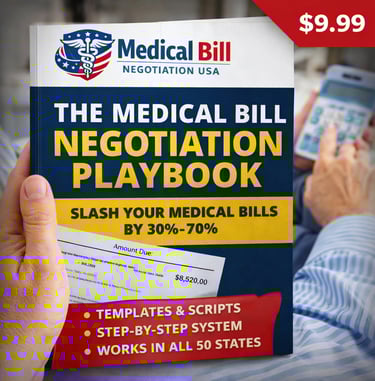
The Medical Bill Negotiation Playbook is designed to walk you through:
Exactly what to say (and what not to say)
How to identify illegal or inflated charges
How to leverage the No Surprises Act effectively
How to negotiate settlements that actually stick
How to avoid collections and credit damage
How to handle hospitals, insurers, and billing agencies with confidence
This is not theory. It is a practical, real-world guide built for patients—not professionals.
If this article opened your eyes, the Playbook will give you the tools to act.
Take control now—before another bill steals your peace of mind.
👉 Get the Medical Bill Negotiation Playbook and stop paying bills you don’t owe.
continue
…you don’t owe.
And here is the uncomfortable truth most hospitals, insurers, and billing companies hope you never fully grasp:
The No Surprises Act is not just a shield. It is a sword.
Used correctly, it doesn’t merely protect you from illegal charges—it fundamentally changes the power dynamics of medical billing. Patients who understand this law are no longer passive recipients of bills. They become informed adversaries in a system that was never built to be questioned.
So let’s go deeper. Because the difference between knowing the No Surprises Act exists and using it effectively is often tens of thousands of dollars.
The Psychology of Medical Billing (Why They Expect You to Pay)
To truly use the No Surprises Act, you need to understand the psychology behind medical billing.
Hospitals and billing companies operate on a few core assumptions:
Most patients won’t read the bill carefully
Most patients don’t know the law
Most patients feel intimidated by medical authority
Most patients will pay something just to make the stress stop
This is not cynical speculation. It’s baked into revenue cycle management.
Billing departments are trained to:
Sound confident, even when wrong
Use technical language to discourage questions
Frame bills as “already reviewed” or “final”
Shift responsibility back to the patient
The No Surprises Act disrupts this model—but only when the patient refuses to play the expected role.
The moment you reference the law calmly and accurately, you are no longer a “standard account.” You become a risk.
The Language That Changes Everything
Words matter more than people realize.
There is a massive difference between saying:
“This bill seems really high. Can you explain it?”
And saying:
“This charge appears to violate the No Surprises Act. I am requesting immediate reprocessing as in-network.”
The first invites delay.
The second triggers review.
Here are phrases that consistently escalate cases internally:
“No Surprises Act violation”
“Balance billing prohibition”
“Lack of valid notice and consent”
“Emergency services under federal protection”
“I am prepared to file a federal complaint”
You are not threatening.
You are signaling competence.
Billing representatives are trained to de-escalate emotional patients. They are not trained to argue federal law with informed ones.https://medicalbillnegotiationusa.com/medical-bill-negotiation-playbook
How Hospitals Try to Reframe Illegal Bills
When a provider knows a bill is shaky, they often pivot tactics rather than admit fault.
Common reframes include:
“This is your deductible”
“Your insurance denied the claim”
“This provider is independent”
“We are still waiting on insurance”
“The law doesn’t apply in this situation”
Each of these statements may sound authoritative—and each may be irrelevant.
The No Surprises Act applies regardless of insurance denial.
It applies regardless of provider independence.
It applies regardless of internal hospital structure.
If the conditions are met, the charge is illegal. Full stop.
Your job is not to debate their explanations. Your job is to return to the statute.
Deductibles, Coinsurance, and the “You Still Owe Something” Myth
One of the most confusing—and commonly abused—areas of medical billing involves cost-sharing.
Hospitals often imply:
“The No Surprises Act doesn’t mean your care is free.”
That statement is technically true—and strategically misleading.
Here’s the reality:
You may still owe in-network deductible or coinsurance
You may not owe out-of-network markups
You may not owe balance billing amounts
You may not be charged arbitrary provider rates
So when a bill drops from $18,000 to $2,400 after reprocessing, that doesn’t mean the law “didn’t work.”
It means it worked exactly as intended.
And even that remaining balance may still be negotiable.
The Quiet Power of Partial Protections
Here is a subtle but critical insight:
Even when only part of a bill is protected under the No Surprises Act, the entire bill becomes vulnerable.
Why?
Because billing systems are interconnected. Once a provider is forced to reprocess one component, the entire account is reviewed. Errors surface. Codes change. Internal notes accumulate.
Many patients report:
Additional reductions after initial disputes
Secondary write-offs “as a courtesy”
Accounts closed with zero balance unexpectedly
Not because of kindness—but because scrutiny is expensive.
The Federal Complaint Process (Why Providers Fear It)
Filing a federal complaint is easier than most people expect—and far more powerful than they realize.
It creates:
A formal record
Regulatory oversight
Internal compliance pressure
Potential penalties
Providers know complaints are tracked.
They know patterns matter.
They know repeated violations draw audits.
That’s why many disputes mysteriously resolve after a complaint is submitted.
You don’t need to threaten this process loudly. Simply stating that you are “prepared to file a complaint if the issue is not resolved” is often enough.
Timing: When to Push, When to Pause
One of the most overlooked skills in medical bill negotiation is timing.
Immediately after receiving a bill:
Do not rush
Do not pay
Do not ignore
Instead:
Request documentation
Open a dispute
Let the clock work for you
Most providers have internal review windows. During these periods, accounts are easier to adjust. Once a bill is sent to collections, leverage changes—but does not disappear.
Even collection agencies must comply with the No Surprises Act.
The Myth of “You Signed Something”
Patients often panic when a provider claims:
“You signed paperwork agreeing to this.”
In reality:
Most signatures are irrelevant
Most forms are legally insufficient
Most waivers are unenforceable
Consent under the No Surprises Act is not casual. It is specific, informed, documented, and voluntary.
If you were:
In pain
Under stress
In an emergency
Not offered alternatives
Not given a clear estimate
Then consent likely does not exist—no matter what was signed.
Using the Law Retroactively
Another common misconception is that the No Surprises Act only applies if you knew about it at the time of care.
That is false.
The law applies retroactively to bills issued after its effective date, regardless of your awareness.
You do not lose protection because you didn’t object immediately.
You do not waive rights by being uninformed.
You do not become responsible because time passed.
Silence is not consent.
How This Law Changes Your Financial Future
Medical debt is one of the leading causes of:
Credit damage
Bankruptcy
Long-term financial instability
The No Surprises Act is not just about one bill. It’s about setting a precedent for how you handle healthcare costs going forward.
Once you learn:
How to read bills critically
How to spot violations
How to assert rights confidently
How to negotiate strategically
You never approach medical charges the same way again.
Fear turns into process.
Confusion turns into clarity.
Helplessness turns into leverage.
Why Most People Still Overpay (Even With the Law)
Despite everything you’ve read, most patients still overpay.
Why?
Because:
They don’t know where to start
They’re afraid of making mistakes
They don’t know what to say
They don’t want to “cause trouble”
They’re exhausted
Hospitals rely on this exhaustion.
That’s why having a structured playbook matters more than raw knowledge.
The Difference Between Random Advice and a System
You can piece together tips from articles, forums, and anecdotes—or you can follow a proven framework.
A system gives you:
Clear steps
Exact language
Decision trees
Escalation paths
Confidence under pressure
It removes guesswork.
It reduces emotional load.
It increases consistency.
That’s exactly what the Medical Bill Negotiation Playbook was built to do.
Final Reality Check
No one is coming to save you from medical billing abuse.
Not your hospital.
Not your insurer.
Not the billing company.
But you are not powerless.
The No Surprises Act is one of the rare moments where the law is clearly on the patient’s side. When you understand it—and when you know how to apply it—it can erase bills, recover money, and protect your financial future.
The only thing standing between you and that outcome is action.
Take the Next Step Now
If you’re facing a medical bill—or want to be prepared before the next one arrives—don’t rely on memory, stress, or improvisation.
Get the Medical Bill Negotiation Playbook and arm yourself with:
Scripts that work
Strategies that scale
Protections you can actually enforce
Confidence that compounds over time
👉 Get the Medical Bill Negotiation Playbook now—and stop paying for surprises you never agreed to.
And remember: the most expensive medical bill is the one you pay without questioning.
continue
without questioning.
But there is still a deeper layer to understand—one that separates patients who occasionally win disputes from those who consistently eliminate unfair medical charges entirely.
Because the No Surprises Act is not isolated. It interacts with insurance law, contract law, billing practices, and behavioral leverage in ways that are rarely explained to patients.
And once you understand those interactions, you stop reacting to medical bills—and start controlling outcomes.
The Structural Weakness in Medical Billing Systems
Medical billing systems are not built for accuracy. They are built for throughput.
Hospitals process:
Thousands of claims per day
Multiple payer rules
Constantly changing reimbursement schedules
Fragmented provider groups
Outsourced billing vendors
Errors are not exceptions. They are routine.
The No Surprises Act increases pressure on systems that were already strained. Compliance requires:
Correct provider classification
Accurate network status
Timely disclosure
Proper coding
Correct patient responsibility calculation
Any weakness in this chain creates leverage for you.
This is why large bills often collapse when challenged—not because the hospital is generous, but because defending the bill is harder than fixing it.
The Silent Shift Inside Billing Departments
Since the No Surprises Act took effect, many billing departments quietly changed internal policies.
Accounts are now often flagged as:
“NSA risk”
“Potential balance billing exposure”
“Requires compliance review”
These flags do not benefit patients who pay quietly.
They benefit patients who force the review.
Once an account enters compliance review:
Adjustments become easier
Supervisors get involved
Legal risk is assessed
Write-offs become acceptable
Your goal is not to argue endlessly.
Your goal is to trigger that internal process.
The Power of Asking for “Written Confirmation”
Here is a simple but devastatingly effective tactic:
Always ask for written confirmation.
Not explanations.
Not verbal assurances.
Written confirmation.
For example:
“Please confirm in writing that this charge complies with the No Surprises Act.”
“Please provide written documentation showing valid notice and consent.”
“Please confirm in writing that this provider was exempt from NSA protections.”
Most representatives will hesitate.
Some will deflect.
Many will escalate.
Why?
Because writing creates liability.
Verbal misinformation disappears.
Written statements do not.
How Insurance Companies Actually Respond
Patients often assume insurance companies are indifferent. That’s only partially true.
Insurers:
Hate regulatory exposure
Hate federal complaints
Hate being named in disputes
Hate paying IDR fees
When you frame an issue as a No Surprises Act compliance problem, you are no longer asking for customer service—you are raising a regulatory issue.
This changes the internal routing of your case.
Claims that might have been denied casually are reprocessed carefully.
Representatives who might have brushed you off involve supervisors.
Documentation suddenly matters.
Why “Out-of-Network” Is No Longer a Scare Word
Before the No Surprises Act, “out-of-network” was terrifying.
Now, it’s contextual.
Out-of-network only matters when:
You knowingly chose the provider
You were given valid notice
You consented properly
Otherwise, it is largely irrelevant.
Hospitals still use the term because it sounds final.
It isn’t.
The law does not ask whether a provider is out-of-network.
It asks whether you should bear the financial consequences of that status.
In many cases, the answer is no.
The Escalation Ladder (And Why It Works)
Effective medical bill negotiation follows a predictable escalation ladder.
You start with:
Information requests
Written disputes
Insurance involvement
You escalate to:
4. Supervisor review
5. Compliance references
6. Federal complaint readiness
You rarely need to go further.
Most disputes resolve between steps 3 and 5—not because you’re aggressive, but because the cost-benefit analysis shifts.
Providers ask themselves:
Is this bill worth defending?
Is this account worth regulatory attention?
Is this worth staff time?
Often, the answer is no.
Emotional Detachment as a Tactical Advantage
This may sound counterintuitive, but emotion weakens your position.
Anger feels justified—but calm confidence is more effective.
When you speak:
Slowly
Precisely
Without apology
Without aggression
You disrupt expectations.
Billing representatives are trained to manage emotional callers.
They are not trained to spar with composed, informed ones.
Silence after stating a fact is often more powerful than arguing it.
The Role of Persistence (Without Burnout)
Persistence does not mean endless phone calls.
It means:
Following up in writing
Referencing previous communications
Maintaining a paper trail
Letting time pressure work against them
Many providers rely on attrition.
They assume you will get tired.
When you don’t, they move on to easier accounts.
How the No Surprises Act Interacts With Negotiation Discounts
Here’s a critical insight most people miss:
Even when a bill is technically compliant, providers still negotiate differently post-NSA.
Why?
Because:
They don’t want disputes
They don’t want complaints
They don’t want scrutiny
They don’t want precedent
So even if you owe:
$2,000
$3,500
$6,000
You may still negotiate reductions by:
Offering lump-sum settlement
Demonstrating hardship
Citing billing complexity
Leveraging compliance fatigue
The law doesn’t eliminate negotiation.
It amplifies it.
The Long Game: Training Providers How to Treat You
Every interaction you have trains the system.
When you:
Ask questions
Demand clarity
Assert rights
Refuse pressure
Providers learn that billing you is expensive.
This matters more than people realize.
Patients who challenge bills consistently report:
Faster resolutions over time
Fewer aggressive collection attempts
More proactive adjustments
Better outcomes overall
You become a “high-friction” account—in the best possible way.
Why This Matters Even If You’re Healthy
Many people assume:
“I’ll deal with this if it happens.”
But the worst time to learn medical billing is during a crisis.
Illness, injury, emergencies—these are moments of vulnerability. The stress compounds. Decisions happen fast. Bills arrive later.
Preparation is not paranoia.
It is financial hygiene.
Understanding the No Surprises Act before you need it changes everything.
What Happens If You Do Nothing
Let’s be brutally honest.
If you do nothing:
Bills go to collections
Credit suffers
Stress compounds
Options narrow
Leverage disappears
Not because you were wrong—but because silence favors the system.
The law does not enforce itself.
Rights unused might as well not exist.
The One Thing That Makes All the Difference
People often ask:
“What’s the single most important factor in winning medical bill disputes?”
It’s not intelligence.
It’s not education.
It’s not income.
It’s structure.
A clear process removes fear.
A script removes hesitation.
A plan removes overwhelm.
That is why the Medical Bill Negotiation Playbook exists.
Final Push: Don’t Leave This to Chance
If you’ve read this far, you already understand something most patients never will:
Medical bills are not fixed facts.
They are starting positions.
The No Surprises Act gives you legal backing.
The Playbook gives you execution.
Together, they give you control.
👉 Get the Medical Bill Negotiation Playbook now and turn confusion into leverage, stress into strategy, and unfair bills into closed accounts.
Because the system counts on you giving up.
And now—you won’t.
Help
Lower your medical bills with expert support
Contact
infoebookusa@aol.com
© 2026. All rights reserved.