Medical Bill Negotiation Tips That Actually Save Money
Blog post description.
2/3/202619 min read

Medical Bill Negotiation Tips That Actually Save Money
Medical bills are one of the few expenses in modern life that can financially ambush you without warning.
You can do everything “right.”
Have insurance.
Choose an in-network hospital.
Follow doctor instructions.
Avoid unnecessary care.
And still open your mailbox weeks later to find a bill so large it makes your stomach drop.
A $3,200 ER visit for “observation.”
A $1,480 lab charge you never approved.
A $900 “facility fee” for a 12-minute appointment.
A balance bill after insurance that feels completely arbitrary.
Here’s the uncomfortable truth most people don’t realize until it’s too late:
Medical bills are not fixed prices. They are starting points for negotiation.
https://medicalbillnegotiationusa.com/medical-bill-negotiation-playbook
Hospitals, clinics, physicians, and collection agencies expect a percentage of patients to negotiate, delay, or reduce what they owe. The system is designed that way. The sticker price is inflated, inconsistent, and often disconnected from the actual cost of care.
This article will walk you—step by step—through medical bill negotiation tactics that actually save money, not vague advice, not feel-good tips, but strategies used by billing professionals, patient advocates, and people who routinely cut their medical debt by 30%, 50%, even 70% or more.
You will learn:
Why medical bills are negotiable (and why hospitals won’t admit it)
How to read a bill like an insider
Exactly when and how to negotiate
The phrases that get results—and the ones that backfire
How to reduce bills even if you’re insured
What to do when a bill goes to collections
How to protect your credit while negotiating
Real examples of negotiations that worked
This is not theory. This is practical leverage.
Why Medical Bills Are Negotiable (Even When They Say They Aren’t)
Hospitals love to project authority. Bills are printed on official letterhead, covered in codes, and worded to sound final.
But behind the scenes, the medical billing system is shockingly flexible.
Here’s why.
1. Chargemaster Pricing Is Artificial
Every hospital maintains a document called a chargemaster—a massive list of prices for every procedure, supply, and service.
These prices are not based on:
What care actually costs
What most people pay
What insurance companies pay
They are inflated numbers designed for negotiation with insurers.
Insurance companies rarely pay chargemaster prices. They negotiate discounts of 40–80% or more. Cash-pay patients and uninsured patients, however, are often billed the full, inflated amount unless they push back.
That alone tells you everything you need to know:
If insurers can negotiate, so can you.
2. Hospitals Expect Non-Payment
Hospitals operate knowing that:
Some patients will never pay
Some bills will go to collections
Some debt will be written off
Because of this, a reduced payment today is often preferable to a full bill that never gets paid.
This is leverage.
3. Billing Errors Are Common—Not Rare
Medical billing errors are not edge cases. They are routine.
Duplicate charges
Incorrect codes
Services not received
Upcoding
Out-of-network mistakes
Clerical errors
Multiple studies have found error rates ranging from 20% to over 80%, depending on complexity of care.
Hospitals know this. They also know most patients will not challenge them.
4. Financial Assistance Programs Exist (Even If You “Don’t Qualify”)
Nearly all nonprofit hospitals—and many for-profit ones—have:
Financial assistance policies
Hardship discounts
Self-pay reductions
Prompt-pay discounts
These are rarely advertised. They are offered after you ask.
The Biggest Mistake People Make With Medical Bills
Before we talk strategy, we need to address the most damaging mistake patients make:
Paying the Bill Immediately Without Question
People pay medical bills quickly because:
They’re afraid of collections
They assume prices are fixed
They feel guilty or embarrassed
They’re emotionally exhausted after illness or injury
Hospitals rely on this psychology.
Once you pay in full, your leverage disappears. Refunds are possible, but they are far harder than negotiating before payment.
If you remember only one rule from this article, remember this:
Never pay a medical bill in full until you have reviewed, questioned, and negotiated it.
Step One: Pause, Breathe, and Take Control
When a medical bill arrives, do nothing for the first 48 hours except review it.
Medical debt is not like credit card debt. There is time. There are protections. There are steps.
Your goal is not to panic.
Your goal is to gather information.
Step Two: Understand the Bill Before You Negotiate
You cannot negotiate what you don’t understand.
Request an Itemized Bill (Always)
Never negotiate using a summary bill.
Call the billing department and say:
“I’m reviewing this charge and I need a fully itemized bill before I can proceed with payment.”
This forces the provider to:
Break down every service
List billing codes
Reveal hidden charges
Many inflated or incorrect charges become obvious only after itemization.
What to Look for on an Itemized Bill
Go line by line and look for:
Duplicate charges
Same test, same medication, same service listed twice.Services you did not receive
Medications you weren’t given, procedures you never consented to.Upcoding
Being billed for a more complex service than what occurred.Out-of-network providers at in-network facilities
Especially common with anesthesiologists, radiologists, and ER physicians.Vague descriptions
“Miscellaneous,” “supplies,” “other services” without explanation.
You do not need medical expertise. If you don’t recognize something, that’s reason enough to question it.
Step Three: Verify Insurance Processing (Even If You’re Insured)
If you have insurance, do not assume the bill is correct.
Compare the medical bill to your Explanation of Benefits (EOB).
Your EOB is not a bill. It shows:
What was billed
What insurance allowed
What insurance paid
What you may owe
Common insurance-related errors include:
Claims denied incorrectly
Procedures coded improperly
Services billed as out-of-network when they weren’t
Deductibles misapplied
If something doesn’t match, call your insurer first and ask:
“Can you explain why this charge processed this way, and whether it can be reprocessed or appealed?”
Many bills shrink significantly after insurance reprocessing—without you negotiating at all.
Step Four: Decide Your Negotiation Angle
Not all negotiations use the same approach. Choose the angle that fits your situation.
Angle 1: Billing Errors
If you found mistakes, this is your strongest position.
Your tone should be firm, factual, and calm.
You are not asking for a favor.
You are requesting correction.
Angle 2: Self-Pay Discount
If you’re uninsured—or if insurance paid little—you can request the self-pay rate, which is often 30–60% lower than the billed amount.
Angle 3: Financial Hardship
You do not need to be destitute to qualify.
Medical hardship includes:
High deductible plans
Temporary income loss
Medical expenses exceeding a percentage of income
Family financial strain
Hospitals define hardship broadly. Patients define it narrowly. Use their definition.
Angle 4: Prompt-Pay Settlement
If you can pay something now, you can often negotiate a lump-sum settlement for less.
Hospitals value cash flow.
Step Five: Make the Call (What to Say and How to Say It)
Negotiation is not confrontation. It is structured conversation.
Call the billing department—not the general number.
The Opening Script
Start with something like:
“I’m calling about a medical bill I received, and I’m trying to understand my options before making payment.”
This signals cooperation, not refusal.
Ask the Magic Question
After explaining your concern, ask:
“What options are available to reduce this balance?”
This question does three things:
It assumes options exist
It invites the representative to help
It avoids accusations
Silence after this question is powerful. Let them respond.
How to Negotiate for a Lower Amount
If the representative does not immediately offer a reduction, move forward deliberately.
Ask for a Self-Pay or Uninsured Rate
Even if you’re insured, say:
“If I were paying this as a self-pay patient, would the amount be lower?”
Often the answer is yes.https://medicalbillnegotiationusa.com/medical-bill-negotiation-playbook
Ask for a Financial Assistance Review
Say:
“Can you review whether I qualify for any financial assistance, hardship discounts, or billing adjustments?”
They may send you a form. Fill it out.
Do not assume you won’t qualify.
Ask for a Prompt-Pay Discount
If you can pay something now:
“If I’m able to make a payment today, is there a discount available for settling the balance?”
Hospitals routinely reduce balances for this reason.
How Much Should You Ask For?
People often ask for too little.
Here are realistic targets:
Small bills ($500–$2,000): Ask for 30–50% reduction
Medium bills ($2,000–$10,000): Ask for 40–60% reduction
Large bills ($10,000+): Ask for 50–70% reduction or more
You don’t have to justify the number with a spreadsheet. You are negotiating, not proving a theorem.
What If They Say No?
“No” is rarely final.
Billing departments often require:
Multiple calls
Supervisor approval
Documentation
Time
If you hear no, respond with:
“Who would be the best person to speak with about reviewing this further?”
Or:
“Is there a supervisor or patient advocate who handles balance adjustments?”
Polite persistence works.
Negotiating in Writing (When Calls Don’t Work)
Sometimes phone calls stall. Written requests create a paper trail.
Send a short letter or secure message stating:
You are disputing or requesting review
You are requesting itemization or adjustment
You are not refusing payment
You are asking for resolution before payment
Written communication slows collections and signals seriousness.
Payment Plans: The Hidden Negotiation Tool
If reduction is limited, negotiate terms.
Interest-free payment plans:
Prevent collections
Buy time
Preserve credit
Keep negotiation leverage open
Ask:
“Is there an interest-free payment plan available while this balance is under review?”
Even a $25/month plan can stop escalation.
What to Do If the Bill Goes to Collections
Collections are not the end. They are another negotiation phase.
Medical collections agencies:
Buy debt cheaply
Expect settlements
Have flexibility
Key rules:
Do not ignore collection notices
Do not admit liability immediately
Do not give bank access or post-dated checks
You can often settle medical debt in collections for 30–50% of the balance—sometimes less.
Always get settlement terms in writing before paying.
Protecting Your Credit During Negotiation
Medical debt affects credit differently than other debt, but damage is still possible.
To protect yourself:
Communicate in writing
Keep records
Request holds during disputes
Avoid missed deadlines
Monitor your credit report
Many providers will pause collections if they see active engagement.
Real-World Negotiation Examples
Example 1: Emergency Room Bill Reduced by 62%
Initial bill: $3,840
After itemization and insurance reprocessing: $2,900
After self-pay negotiation: $1,450
Final settlement: $1,100
Savings: $2,740
Example 2: Lab Charges Eliminated
Initial bill: $1,260
Duplicate labs identified
Insurance reprocessed
Final bill: $0
Savings: $1,260
Example 3: Surgery Balance Cut in Half
Initial balance after insurance: $7,800
Financial hardship application submitted
Prompt-pay offer made
Final settlement: $3,900
Savings: $3,900
These outcomes are not rare. They are normal for patients who push back.
The Emotional Side of Medical Bill Negotiation
Negotiating medical bills feels uncomfortable because:
Illness makes people vulnerable
Money conversations trigger shame
Authority figures intimidate
But remember this:
You are not asking for charity. You are correcting a broken pricing system.
Hospitals are businesses. Negotiation is part of their model. You are simply participating in it.
Why Most People Fail (And How You Won’t)
Most people fail to save money on medical bills because they:
Don’t ask
Ask once and stop
Accept the first answer
Pay too quickly
Feel intimidated
You won’t—because you now understand the system.
And because you have something most patients don’t: a playbook.
The Difference Between Random Tips and a System
Reading tips helps.
Having a step-by-step negotiation system changes outcomes.
There are scripts.
Checklists.
Timelines.
Escalation paths.
Settlement strategies.
The difference between saving $200 and saving $5,000 is rarely effort—it’s structure.
Your Next Step (Critical)
If you or someone you care about has:
A large medical bill
Multiple bills from one visit
A bill in collections
High deductibles
Confusing insurance balances
You need more than general advice.
You need a repeatable system you can apply confidently—without guessing what to say or when to say it.
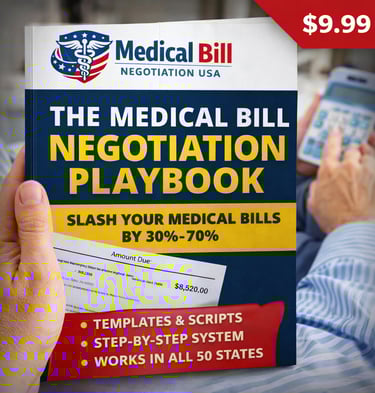
👉 Get the Medical Bill Negotiation Playbook
The Medical Bill Negotiation Playbook walks you through:
Exact scripts for every negotiation stage
How to respond to pushback
When to escalate and to whom
How to document negotiations
How to handle collections safely
How to negotiate even after payment
How to protect your credit throughout the process
This is not theory.
It’s a field manual designed to save real money—fast.
If one negotiation saves you even a fraction of a single bill, the playbook pays for itself many times over.
Don’t guess. Don’t panic. Don’t overpay. https://medicalbillnegotiationusa.com/medical-bill-negotiation-playbook
👉 Get the Medical Bill Negotiation Playbook and take control of your medical costs—starting today.
And once you understand how this system really works, you’ll never look at a medical bill the same way again—because the moment you stop seeing it as a demand and start seeing it as a negotiation, everything changes, and the power shifts back to you in a way that most patients never experience, especially when you begin applying these strategies consistently across every provider, every bill, and every interaction with the healthcare system, turning what once felt like an unavoidable financial hit into a process you can manage, control, and continue to refine over time as you build confidence, documentation, leverage, and the ability to calmly navigate even the most complex medical billing scenarios without fear, hesitation, or unnecessary payment of charges that were never truly set in stone in the first place, because the reality is that medical billing is not a fixed destination but an ongoing conversation—one that rewards those who stay engaged, informed, persistent, and strategic enough to continue pushing forward even when the system initially resists, delays, or obscures the truth behind its numbers, and that is exactly why the next step you take matters more than anything else you have done so far, because from this point on, you are no longer reacting—you are negotiating, and once you truly internalize that shift, you will start seeing opportunities to reduce costs everywhere you look, whether it’s a routine lab test, a specialist visit, a hospital stay, or a surprise balance bill that lands in your mailbox weeks later, demanding payment as if no alternatives exist, when in fact those alternatives are already there, waiting for you to activate them by continuing to apply the principles, scripts, and strategies you’ve begun to learn here, which is why the most important thing you can do right now is not to stop, not to assume you’ve learned enough, and not to settle for partial savings when full leverage is still within reach, because the moment you stop engaging is the moment the system wins—and as long as you continue, ask, document, escalate, and negotiate, you remain in control of the outcome, no matter how complex or intimidating the bill may appear at first glance, and that control is what ultimately separates patients who overpay from those who consistently save thousands of dollars over the course of their lives by refusing to accept medical bills at face value and instead treating them for what they truly are: negotiable starting points in a system that was never designed to be transparent, fair, or final without your active participation in the process.
continue
…process, and once you truly internalize that reality, something subtle but powerful happens: you stop feeling rushed, pressured, or intimidated by deadlines printed on paper, automated phone messages, or bold red “DUE NOW” language designed to trigger anxiety rather than accuracy, and instead you begin approaching each bill with the calm, methodical mindset of someone who understands that time is leverage, information is leverage, and persistence compounds leverage in ways most patients never exploit.
Advanced Medical Bill Negotiation Tactics Most People Never Use
Once you’ve mastered the fundamentals—itemization, verification, initial negotiation—you can begin applying advanced strategies that dramatically increase savings, especially on large or complex bills.
These are the tactics used by professional medical bill advocates, insiders who know how the system actually behaves under pressure.
Leveraging Time as a Negotiation Weapon
Hospitals want closure.
Accounting departments want balances resolved.
Quarterly reporting cycles matter more than individual bills.
You can use this.
Why Delaying (Strategically) Works
Medical providers escalate slowly. Very slowly.
In most cases:
Bills do not go to collections for 90–180 days
Internal reviews take weeks
Supervisors batch approvals monthly
Charity and hardship reviews are backlogged
By remaining responsive—but not rushed—you position yourself as:
Cooperative
Engaged
Likely to pay something
Worth negotiating with
Silence gets punished.
Engagement gets flexibility.
How to Delay Without Risk
You are not ignoring the bill. You are actively reviewing it.
Use phrases like:
“I’m waiting on itemized documentation.”
“Insurance is reviewing this claim.”
“I’ve submitted a financial assistance application.”
“I’m awaiting supervisor review.”
Each of these pauses escalation.
The Escalation Ladder (Who to Talk to and When)
Not all billing reps have authority.
Most can:
Set payment plans
Apply small courtesy discounts
Note the account
Few can:
Approve large reductions
Apply hardship write-offs
Override policy
The Escalation Ladder
Front-line billing representative
Senior billing specialist
Billing supervisor
Patient financial services manager
Hospital patient advocate
Financial assistance office
External patient advocacy department
You don’t jump straight to the top. You climb deliberately.
How to Escalate Without Sounding Difficult
Say:
“I appreciate your help. Is there someone who reviews balances for adjustment or hardship cases?”
This keeps the tone cooperative while moving upward.
Using Language That Triggers Flexibility
Negotiation is not about aggression. It’s about framing.
Certain phrases consistently open doors.
High-Impact Phrases That Work
“I’m trying to resolve this responsibly.”
“This balance presents a financial hardship for my household.”
“I’m looking for a fair resolution.”
“What flexibility exists here?”
“I want to avoid collections if possible.”
“I’m willing to settle this today if we can agree on an amount.”
Phrases That Backfire
Avoid:
“This is ridiculous.”
“I refuse to pay.”
“You’re overcharging me.”
“I’m getting a lawyer.”
“I’ll just let it go to collections.”
Threats close doors. Calm persistence opens them.
Negotiating When You’ve Already Paid (Yes, It’s Possible)
Many people don’t realize this: payment does not always end negotiation.
If you:
Paid under pressure
Paid before seeing itemization
Paid while insurance was pending
Paid without knowing about discounts
You may still be able to recover money.
How Refund Negotiation Works
Call billing and say:
“I paid this balance before fully understanding the charges, and I’d like to request a review for possible adjustment or refund.”
Hospitals issue refunds more often than you’d think—especially when:
Errors are discovered
Insurance reprocesses claims
Hardship status is approved retroactively
It’s harder than pre-payment negotiation—but far from impossible.
Negotiating Multiple Bills From One Visit
Hospital visits often generate multiple bills:
Hospital facility fee
Physician bill
Anesthesia
Radiology
Lab services
Each is negotiable independently.
Why This Matters
If you negotiate them together, you lose leverage.
Instead:
Handle each provider separately
Use settlement outcomes as leverage with others
Mention hardship consistently across all
Example:
“I’ve already negotiated reductions with two providers related to this visit, and I’m working to resolve all balances fairly.”
This signals seriousness and consistency.
Handling Surprise Bills and Balance Billing
Surprise bills are common, especially after emergency care.
Even with insurance, you may receive bills from out-of-network providers you never chose.
What to Do Immediately
Verify whether surprise billing protections apply
Contact your insurer and ask about appeal rights
Request in-network reclassification
Ask the provider for a courtesy adjustment
Many surprise bills are reduced dramatically—or eliminated—after pressure.
Negotiating With Collections Agencies (The Right Way)
Once a bill enters collections, fear increases—but so does flexibility.
Collections agencies buy medical debt for pennies on the dollar.
That’s your leverage.
Golden Rules for Collections Negotiation
Never admit liability immediately
Request written validation of the debt
Negotiate lump-sum settlements
Get everything in writing
Never give direct bank access
Settlement Targets in Collections
Recent collections: 40–60%
Older collections: 20–40%
Purchased debt: Sometimes less
Always negotiate removal or non-reporting if possible.
How to Negotiate When Money Is Truly Tight
If finances are strained, honesty helps.
You do not need to overshare—but clarity matters.
Say:
“I want to resolve this, but paying the full amount would create significant hardship. I’m asking for a reduction or assistance.”
Hospitals prefer partial payment to none.
And many nonprofit hospitals are legally required to offer financial assistance—whether they advertise it or not.
Building a Negotiation Paper Trail
Documentation protects you.
Keep:
Dates and times of calls
Names and extensions
Summary of discussions
Copies of letters and forms
Screenshots of balances
This creates credibility—and leverage if disputes arise later.
The Psychology of Winning Medical Negotiations
Here’s a truth most people never hear:
The system expects resistance from a small percentage of patients—and rewards them.
You are not being difficult.
You are being competent.
Hospitals build inflated pricing knowing:
Some will negotiate
Some will default
Some will overpay
You decide which category you fall into.
Why This Skill Pays Off for Life
Medical bills don’t disappear with age.
They increase:
As deductibles rise
As care becomes more complex
As insurance shifts costs to patients
Learning how to negotiate once saves money repeatedly:
For yourself
For your family
For aging parents
For children
For emergencies
This is a life skill, not a one-time tactic.
The Difference Between Hoping and Executing
Most patients hope:
The bill is correct
Insurance catches errors
The amount is fair
Smart patients execute:
Review
Question
Negotiate
Document
Escalate
Settle strategically
Hope is passive.
Execution saves money.
Why Scripts Matter More Than Confidence
You don’t need to sound confident.
You need to sound prepared.
Scripts remove emotion and guesswork.
Knowing exactly what to say:
Reduces anxiety
Prevents mistakes
Keeps conversations focused
Signals seriousness
That’s why professionals rely on them.
The Cost of Not Negotiating
Failing to negotiate medical bills costs:
Thousands of dollars over a lifetime
Stress and anxiety
Credit damage
Lost savings
Delayed financial goals
And worst of all—it’s avoidable.
The Moment That Changes Everything
There is a moment every successful negotiator experiences.
It’s when a billing representative says:
“Let me see what I can do.”
That sentence means you’ve shifted the conversation from payment demand to problem-solving.
And that shift is where savings happen.
Final Call to Action: Take Control Now
If you’ve read this far, you already understand something most people never do:
Medical bills are not fixed.
They are negotiable.
And negotiation works.
But knowing that is not enough.
You need:
Exact scripts
Clear timelines
Escalation paths
Settlement strategies
Collection defense tactics
Documentation templates
That’s exactly what the Medical Bill Negotiation Playbook gives you.
👉 Get the Medical Bill Negotiation Playbook
Inside, you’ll find:
Step-by-step negotiation workflows
Word-for-word scripts for every scenario
Strategies for insured and uninsured patients
Tactics for large bills and collections
Credit-protection guidance
Real-world examples you can model
One successful negotiation can save more than the cost of the playbook—sometimes thousands of dollars.
Don’t rely on guesswork.
Don’t overpay out of fear.
Don’t assume the bill is final.
👉 Get the Medical Bill Negotiation Playbook and turn medical bills into negotiable conversations you know how to win, because once you stop treating medical bills as immovable obligations and start treating them as adjustable financial events that respond to preparation, persistence, and strategic communication, you gain something far more valuable than a reduced balance—you gain confidence, control, and the ability to navigate the healthcare system on your terms, again and again, no matter how complex or intimidating the numbers may look at first glance, and that ability will continue paying dividends long after a single bill is resolved, as you apply the same principles to future charges, unexpected expenses, and situations where most people freeze or overpay, while you calmly step forward, engage the process, and continue negotiating until the outcome reflects not what the system demanded, but what was fair, reasonable, and financially sustainable for you and the people you care about most, which is exactly where every medical bill should ultimately land when handled correctly, deliberately, and without apology, because the system only feels rigid to those who stop asking—and as long as you continue asking, reviewing, escalating, and negotiating, the process never truly ends, it simply continues working in your favor, one conversation at a time, for as long as you choose to stay in control.
continue
…control, and that control becomes almost addictive once you realize how consistently it produces results, because every successful negotiation reinforces the same lesson: the system responds to persistence, not urgency, and to structure, not emotion, which means the more you use these strategies, the easier they become to apply, even in moments of stress, illness, or financial pressure, when most people default to avoidance or blind payment instead of deliberate action.
Handling High-Dollar Medical Bills Without Panic
When medical bills climb into the tens of thousands of dollars, fear becomes the dominant emotion—and fear is exactly what hospitals and billing departments count on.
Large bills feel existential.
They trigger worst-case thinking.
They make people believe negotiation “won’t matter.”
That belief is wrong.
Why Large Bills Are Often the Most Negotiable
The bigger the bill, the more flexibility exists.
Why?
Hospitals expect a percentage of large bills to go unpaid
Insurance rarely covers full amounts
Internal write-offs are common
Accounting departments prefer partial recovery to default
Supervisory approval is easier to justify on large balances
A $200 bill may not be worth negotiating internally.
A $20,000 bill absolutely is.
The Large-Bill Negotiation Framework
When dealing with large balances, you don’t negotiate impulsively—you follow a sequence.
Step 1: Break the Bill Apart
Large bills are almost always composites:
Facility fees
Professional fees
Ancillary services
Equipment charges
Negotiate each component separately whenever possible.
Step 2: Force Full Transparency
Demand:
Itemized bills
Coding explanations
Insurance reprocessing
Written confirmation of balances
Opacity benefits them. Transparency benefits you.
Step 3: Apply Multiple Angles at Once
You are not limited to one approach.
You can simultaneously:
Dispute coding
Apply for hardship assistance
Request self-pay rates
Offer prompt-pay settlement
Negotiate payment terms
These pressures stack.
Step 4: Anchor Low (Politely)
When proposing a settlement, start lower than your target.
If you’re comfortable paying $5,000 on a $15,000 bill, propose $3,500.
Negotiation needs room to move.
The Role of Patient Advocates (And When to Use Them)
Hospitals employ patient advocates—not to save you money, but to reduce complaints and regulatory risk.
That works in your favor.
When to Contact a Patient Advocate
Billing feels unresponsive
Errors persist
You’re being bounced between departments
Hardship requests stall
You feel stonewalled
Patient advocates:
Navigate internal systems
Escalate issues
Coordinate departments
Document disputes
You are not “making trouble.”
You are using the system provided.
Negotiating After Insurance Denials
Insurance denials are common—and frequently incorrect.
Do not accept them automatically.
First Response to a Denial
Call your insurer and ask:
“Can you explain the specific reason for this denial and whether it’s appealable?”
Then ask:
“What documentation would support an appeal?”
Many denials reverse on appeal.
If Insurance Won’t Budge
You still negotiate with the provider.
Say:
“Insurance denied coverage, and paying this balance would cause hardship. I’m requesting a self-pay adjustment or reduction.”
Providers know denials happen. They also know patients cannot absorb full charges easily.
How to Negotiate Medical Bills for Family Members
Medical bills don’t just affect individuals—they affect families.
You may negotiate for:
Children
Elderly parents
Disabled relatives
Spouses
Key Considerations
Obtain authorization if needed
Keep documentation organized
Use consistent language across providers
Emphasize household impact
Hospitals often respond favorably when you demonstrate active involvement and responsibility.
Using Financial Hardship Strategically (Without Oversharing)
Hardship does not mean poverty.
It means:
The bill is unreasonable relative to income
Medical costs exceed typical expenses
Payment would disrupt basic financial stability
You can state hardship without disclosing every detail.
Say:
“This balance represents a significant financial hardship for our household given our current obligations.”
That is enough.
Negotiating Medical Bills Without Insurance
Uninsured patients are often billed the highest prices—but they also have the most leverage.
Why?
No insurer negotiated on your behalf
Providers expect discounts
Charity care applies more broadly
Cash settlements are attractive
Immediate Steps if You’re Uninsured
Request self-pay pricing immediately
Ask for financial assistance
Negotiate before any payment
Avoid setting payment plans before reductions
Uninsured patients routinely save 50–80% when negotiating correctly.
Avoiding Common Negotiation Traps
Trap 1: Accepting the First Discount
The first offer is rarely the best.
Always ask:
“Is that the best you can do?”
Trap 2: Agreeing Verbally Without Confirmation
Always request:
Written confirmation
Updated balance
Settlement terms
Trap 3: Letting Deadlines Control You
Deadlines are pressure tools—not absolute rules.
Trap 4: Giving Up Too Soon
Negotiation is a process, not a single call.
The Compounding Effect of Negotiation Skills
Once you know how to negotiate medical bills, something interesting happens:
You start reviewing bills automatically
You ask better questions
You feel less anxious
You save money repeatedly
You help others do the same
This skill compounds over time.
Why the Healthcare System Doesn’t Teach This
If everyone negotiated:
Pricing transparency would collapse
Inflated chargemasters would fail
Revenue models would change
The system survives on silence.
You break that silence by participating.
The Ethical Side of Medical Bill Negotiation
Some people hesitate because they think negotiating is unethical.
It’s not.
Hospitals:
Inflate prices intentionally
Negotiate with insurers aggressively
Write off debt routinely
Receive tax benefits and subsidies
Negotiation restores balance—it doesn’t exploit it.
Turning One Negotiation Into a Habit
The goal isn’t to negotiate one bill.
It’s to:
Review every bill
Question every charge
Negotiate whenever possible
Normalize the process
When this becomes habit, savings become inevitable.
The Line Between Stress and Strategy
Medical bills are stressful because they feel uncontrollable.
Strategy removes that stress.
Once you have a system:
You know what to do
You know what to say
You know when to escalate
You know when to settle
Control replaces fear.
Why Most Advice Fails (And Why This Works)
Generic advice says:
“Call and ask”
“Be polite”
“See what happens”
That’s not enough.
Effective negotiation requires:
Structure
Timing
Scripts
Persistence
Documentation
That’s why results vary wildly between people facing identical bills.
The Final Reality Check
Medical bills will not stop coming.
But overpaying can.
The difference is not luck.
It’s leverage.
And leverage comes from preparation.
Your Last, Most Important Decision
You can:
Hope the bill is fair
Pay it and move on
Stress in silence
Or you can:
Negotiate
Reduce
Control
Save
The choice compounds over time.
👉 The Medical Bill Negotiation Playbook (Your Advantage)
The Medical Bill Negotiation Playbook exists for one reason:
To remove uncertainty from medical bill negotiation.
Inside, you get:
Word-for-word scripts
Decision trees
Timelines
Escalation guides
Settlement strategies
Collection defense frameworks
Documentation templates
No guessing.
No hesitation.
No overpaying.
If you ever face another medical bill—and you will—this playbook becomes your default response.
👉 Get the Medical Bill Negotiation Playbook now, because the next bill won’t ask whether you’re ready, but once you’ve equipped yourself with the right system, it won’t matter, since you’ll know exactly how to respond from the moment it arrives, calmly, deliberately, and with a clear path toward reducing what you owe while protecting your finances, your credit, and your peace of mind, and as you continue applying these strategies over time, you’ll discover that what once felt overwhelming has become manageable, repeatable, and even empowering, not because the system suddenly became fair, but because you learned how to work within it on your terms, which is ultimately the only way to ensure that medical care doesn’t quietly erode your financial future one inflated bill at a time, as long as you keep engaging, negotiating, and refusing to accept the first number you’re given as the final answer.
Help
Lower your medical bills with expert support
Contact
infoebookusa@aol.com
© 2026. All rights reserved.