How to Negotiate Medical Bills Step-by-Step (Free Checklist)
Blog post description.
4/16/202611 min read

How to Negotiate Medical Bills Step-by-Step (Free Checklist)
If you are reading this, there is a strong chance you are dealing with a medical bill that does not feel manageable, does not feel fair, or does not make sense. In practice, this usually happens after an already stressful health event, when energy is low and attention is fragmented, yet financial pressure suddenly demands immediate action.
In many cases we see, the bill arrives weeks or months after treatment, long after the patient believed insurance had “handled it.” Sometimes it is one bill. More often, it is a sequence of bills, statements, explanations of benefits, and collection notices that do not align with each other. Patients feel trapped between fear of collections, confusion about their rights, and uncertainty about what to say or when to say it.
This guide is written from the perspective of someone who has observed and assisted many real medical bill negotiations across hospitals, physician groups, imaging centers, emergency departments, and third-party billing offices. It is not theoretical. It is not based on “tips” copied from insurer blogs. It reflects patterns that repeat across medical billing departments and the practical decision-making that actually changes outcomes.
You do not need to be aggressive. You do not need to threaten. You do need to understand timing, leverage, sequencing, and how billing systems actually behave.
We will go step by step, in the order that works in real life.https://medicalbillnegotiationusa.com/medical-bill-negotiation-playbook
Before You Negotiate Anything: Understand the System You’re Dealing With
Why Medical Bills Are Negotiable (Even When They Say They Aren’t)
One pattern that repeats across medical billing situations is that patients assume medical bills are fixed, like taxes or utility bills. In practice, this assumption is incorrect.
Medical billing systems are not designed around a single “price.” They operate with multiple price layers:
Chargemaster rates (the highest, almost never paid)
Insurance-negotiated rates
Self-pay discounts
Prompt-pay discounts
Financial assistance write-offs
Internal settlement thresholds
In many cases we see, the amount printed on the first bill is not the amount the provider expects to collect. It is a starting number that allows room for adjustment based on who pays, how fast, and under what circumstances.
Hospitals and large provider groups plan for a significant percentage of billed charges to be reduced or written off. Your negotiation does not disrupt the system. It activates a path that already exists.
Why Timing Matters More Than Tone
Patients often focus on what to say. In practice, when you say it matters more.
Negotiating too early (before insurance has fully processed) can freeze the account.
Negotiating too late (after the account has been transferred to collections) reduces options.
Negotiating during specific internal windows opens flexibility that does not exist later.
Understanding this sequence is foundational.
Step 1: Pause and Stabilize Before Taking Action
What We See Most Often in Real Negotiations
The most common mistake patients make is reacting immediately to the first bill. Panic leads to rushed payments, emotional calls, or avoidance. None of these help.
In practice, this often happens when the bill amount triggers fear about savings, rent, credit, or family obligations. The instinct is to “do something” just to reduce anxiety.
Instead, the first step is stabilization.
Your Immediate Checklist (Do This Before Any Calls)
Do not pay the bill yet (unless it is clearly a small copay you recognize)
Do not set up a payment plan yet
Do not ignore deadlines—but understand them first
Gather all related documents in one place:
Bills
Explanation of Benefits (EOBs)
Insurance policy summary
Any letters from the provider or insurer
This pause gives you leverage. Once money moves, leverage shrinks.
Step 2: Separate Insurance Processing From Provider Billing
Why So Many Bills Are Wrong (or Premature)
In many cases we see, patients are billed before insurance processing is complete. This creates confusion and unnecessary stress.
Billing departments and insurance companies operate on separate timelines. Providers often send bills automatically once a claim is submitted, not when it is resolved.
How to Identify an “Unsettled” Bill
Look for these signs:
The bill says “this is not a final bill”
The EOB shows “pending,” “adjustment,” or “patient responsibility TBD”
The bill arrives before you receive an EOB
Multiple bills arrive for the same service date
If any of these apply, you are not negotiating yet. You are verifying.
What to Say at This Stage (Simple, Non-Emotional)
“I received a bill for this date of service, but I’m still waiting for insurance to fully process the claim. Can you confirm the claim status and place the account on hold?”
In practice, this often pauses collections and buys time without confrontation.
Step 3: Demand an Itemized Bill (Even If You Think You Have One)
Why Itemization Changes Power Dynamics
One pattern that repeats across hospital billing departments is that itemized bills slow the system down—and that helps you.
Many bills patients receive are summary statements, not true itemizations. They combine dozens of line items into vague categories.
An itemized bill forces internal review.
What a Real Itemized Bill Includes
Individual service codes (CPT / HCPCS)
Dates and times
Unit counts
Per-unit charges
Provider identifiers
In many cases we see, requesting itemization alone leads to partial reductions before negotiation even begins.
How to Request It (Exactly)
“I’m requesting a fully itemized statement for this account, including CPT codes, unit counts, and charges for each service.”
Do not explain. Do not justify. This is a normal request.
Step 4: Identify Errors Before You Negotiate Price
The Most Common Billing Errors We See
Before discussing discounts, look for errors. Negotiating a wrong bill wastes leverage.
Patterns that repeat:
Duplicate charges
Services not received
Incorrect quantity (e.g., multiple units of a single service)
Upcoding (higher-level service than documented)
Facility fees added unexpectedly
Out-of-network providers at in-network facilities
In practice, even large hospitals make routine errors. Catching them changes the tone of future conversations.
How to Flag Errors Without Accusation
“I’m reviewing the itemized statement and see charges I don’t recognize. Can you help me understand these line items?”
This keeps the interaction collaborative while forcing review.
Step 5: Understand Your Leverage Position
Not All Patients Have the Same Negotiation Power
In real negotiations, leverage comes from context, not confidence.
Factors that increase leverage:
Self-pay or high-deductible status
Financial hardship
Timing before collections
Large balance relative to income
Provider’s internal settlement thresholds
Factors that reduce leverage:
Already on a payment plan
Partial payments made
Account in third-party collections
Small balances below adjustment thresholds
Understanding where you stand determines which strategy to use.
Step 6: Choose the Right Negotiation Path
Three Core Negotiation Paths We See Work
In practice, almost all successful outcomes fall into one of these paths:
Path A: Financial Assistance / Hardship Adjustment
Best when income constraints are real and documentable.
Path B: Self-Pay or Prompt-Pay Settlement
Best when you can offer a lump sum.
Path C: Structured Reduction + Payment Plan
Best when cash flow exists but full payment is unrealistic.
Choosing the wrong path wastes time.
Step 7: How to Negotiate a Lump-Sum Reduction (The Most Effective Method)
Why Lump-Sum Offers Work
One pattern that repeats across medical billing departments is a preference for certainty over maximum theoretical revenue.
A guaranteed payment today is often worth more internally than a larger balance paid over years.
When to Make the Offer
After insurance is finalized
After errors are corrected
Before collections escalation
How to Frame the Conversation
“I want to resolve this balance, but the full amount isn’t financially possible for me. If I can make a one-time payment, is there flexibility to settle the account for a reduced amount?”
Pause. Let them respond.
In many cases we see, the first offer is not the final one.https://medicalbillnegotiationusa.com/medical-bill-negotiation-playbook
Typical Settlement Ranges We See
20–40% reductions: common
50–60% reductions: achievable
70%+ reductions: possible in hardship cases
These are not guarantees. They are observed patterns.
Step 8: Negotiating Without Disclosing Too Much
What Not to Say
Patients often overshare. This weakens leverage.
Avoid:
Exact savings amounts
Retirement balances
Emotional explanations
Apologies
What to Emphasize Instead
Fixed financial limits
Desire to resolve
Willingness to pay something
Need for clarity
In practice, calm constraint outperforms emotional persuasion.
Step 9: Financial Assistance Programs (How They Actually Work)
What We See Most Often in Real Negotiations
Hospitals rarely advertise how generous these programs can be.
Many patients assume assistance is only for the uninsured or unemployed. In practice, this often happens even for insured, employed patients with medical debt disproportionate to income.
Key Insight
Eligibility is often based on income relative to medical expense, not income alone.
A household earning $70,000 may qualify if the bill is $15,000.
How to Trigger Review Without Shame
“I’d like to apply for any financial assistance or hardship programs available. Can you tell me the process and documentation required?”
This opens a parallel path that can dramatically reduce balances.
Step 10: When Providers Say “We Don’t Negotiate”
Why This Happens
Front-line representatives often lack authority. Their scripts are designed to close calls, not solve problems.
This is not the end.
What to Do Next
Ask for a supervisor or billing manager
Request escalation notes on the account
Call back at a different time
Use written communication
One pattern that repeats: persistence without aggression works.
Step 11: Payment Plans as a Strategic Tool (Not a Default)
When Payment Plans Help
To stop collections temporarily
To buy time during assistance review
To maintain goodwill
When They Hurt
They lock in the full balance
They reduce settlement leverage
They normalize the debt internally
In practice, payment plans should be a bridge, not a destination.
Step 12: Dealing With Collections (If You’re Already There)
First: Do Not Panic
Accounts in collections still settle.
However, leverage shifts.
What Changes in Collections
Credit reporting risk increases
Settlement percentages may improve
Documentation becomes critical
In many cases we see, settlements of 30–50% are still possible even in collections, but strategy must adjust.
Step 13: Written Agreements and Final Confirmation
Never Pay Without Confirmation
Before paying:
Get the settlement amount in writing
Confirm it resolves the balance in full
Confirm no residual billing remains
This step prevents reopening later.
Common Mistakes Patients Make
Paying “just to get it over with”
Negotiating before insurance finalizes
Accepting first offers
Ignoring assistance programs
Letting fear drive decisions
These mistakes are understandable under stress. They are also avoidable.
Patterns That Repeat Across Hospital Billing Departments
Delays favor patients
Clarity beats emotion
Documentation unlocks flexibility
Authority increases with escalation
Silence often precedes concessions
Understanding these patterns removes mystery from the process.
A Practical Decision Path (Use This Under Stress)
Is insurance fully processed?
→ If no, pause and verify.Is the bill accurate and itemized?
→ If no, correct first.Can you pay a lump sum at a discount?
→ If yes, negotiate settlement.Is hardship real relative to income?
→ If yes, apply for assistance.Is time needed to prevent collections?
→ Use temporary payment plan strategically.
This is how experienced negotiators think.
Emotional Reality: Why This Feels So Hard
Medical billing triggers fear because it arrives when control already feels lost.
In many cases we see, patients blame themselves for not “understanding insurance” or for needing care in the first place. This is misplaced.
The system is complex by design. Negotiation is not cheating it. It is navigating it.
Free Checklist: What to Do, In Order
Pause before paying
Confirm insurance finalization
Request full itemization
Identify errors
Assess leverage
Choose negotiation path
Make structured offers
Document everything
Confirm resolution in writing
Print this. Use it when stress is high.https://medicalbillnegotiationusa.com/medical-bill-negotiation-playbook
When You Want Structure, Not Guesswork
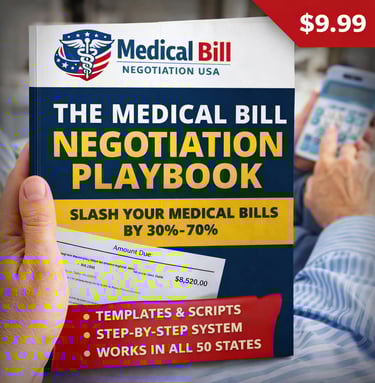
If you want a clear, step-by-step system that removes uncertainty, keeps emotion out of decisions, and shows you exactly what to say, when to say it, and why, the Medical Bill Negotiation Playbook was created for that purpose.
It does not promise miracles. It gives you control, clarity, and a proven decision framework drawn from real cases—not internet shortcuts.
When money is tight, confidence comes from knowing your next move.
That’s what the playbook provides.
If you want to take back control and stop feeling cornered by medical bills, it’s there when you’re ready.
And if you’ve read this far, you already understand why timing, structure, and calm strategy matter more than pressure ever will.
continue
…matter more than pressure ever will.
Deep Dive: The Exact Language That Changes Outcomes (And Why It Works)
When patients struggle in negotiations, it is rarely because they lack justification. It is because they use language that triggers defensive or procedural responses inside billing departments.
In practice, billing staff are trained to route accounts into predefined buckets. Your wording determines which bucket you land in.
Language That Triggers Resistance
Across many real negotiations, these phrases consistently slow or shut down progress:
“This bill is ridiculous.”
“I shouldn’t have to pay this.”
“I’m going to report this.”
“Your prices are insane.”
“I don’t agree with this.”
These statements may be emotionally valid. Operationally, they push your account into a complaint pathway rather than a resolution pathway.
Language That Triggers Flexibility
These phrases repeatedly unlock options:
“I want to resolve this balance.”
“The full amount isn’t financially possible for me.”
“Is there flexibility if I can pay a lump sum?”
“Can you explain what options exist in situations like mine?”
“What is the process for hardship review?”
In practice, this language signals cooperation without surrender.
What We See Most Often in Real Negotiations With Hospitals
Pattern 1: The First Person You Speak To Cannot Help You
Front-line representatives often have limited authority. Their role is to:
Collect payment
Set payment plans
Provide basic explanations
They usually cannot approve settlements, write-offs, or hardship adjustments.
This is not personal. It is structural.
What Actually Works
Ask calmly:
“Is there a billing manager or supervisor who handles settlement reviews?”
Call back at different times.
Different shifts have different discretion cultures.Use written follow-up after verbal conversations.
Persistence without hostility changes outcomes.
The Hidden Power of Silence in Negotiations
One pattern that repeats across medical billing departments is discomfort with unresolved accounts that show engagement but no payment.
When you:
Request itemization
Ask for clarification
Apply for assistance
Ask for time to review options
You create administrative friction. This is not malicious. It is strategic.
In practice, unresolved engaged accounts are more likely to receive concessions than ignored accounts or aggressively disputed ones.
Silence after making an offer can also work in your favor.
When you say:
“That amount still isn’t possible for me. I need to think about next steps.”
…and then stop talking, you often force the other side to fill the gap.
Advanced Strategy: Using Internal Thresholds to Your Advantage
What Patients Rarely Know
Hospitals and large providers operate with internal write-off thresholds. These thresholds determine when continued pursuit costs more than settlement.
While you will never be told the exact numbers, patterns emerge.
In many cases we see:
Balances under certain amounts are easier to reduce
Older balances face more flexibility
Accounts showing financial constraint are deprioritized for aggressive collection
This is why timing and documentation matter.
How Income Documentation Actually Gets Evaluated
A Common Misunderstanding
Patients assume financial assistance reviews are purely mathematical. They are not.
In practice, reviewers look for:
Consistency
Plausibility
Proportionality
A household earning $60,000 with a $12,000 bill may appear more burdened than a household earning $40,000 with a $1,000 bill.
What Strengthens Your Case
Recent pay stubs (not years of history)
Proof of current expenses if requested
A brief explanation of financial strain tied to the medical event
What weakens your case:
Over-explaining
Emotional appeals
Contradictory numbers
Clarity beats sympathy.
Common Mistakes Patients Make During Assistance Applications
Missing deadlines
Submitting incomplete forms
Assuming denial is final
Failing to appeal
In practice, many initial denials are procedural, not substantive.
A follow-up application with clearer documentation often succeeds.
Negotiating After Partial Payments: What Changes
The Reality
Once partial payments are made, billing systems often mark the account as “performing.”
This reduces urgency for concessions.
What Still Works
Escalation to supervisors
Hardship re-evaluation due to changed circumstances
Lump-sum offers framed as final resolution
While leverage is reduced, it is not gone.
Emergency Room Bills: Why They Are Different
Patterns That Repeat in ER Billing
Multiple separate bills (facility, physician, imaging)
Out-of-network providers without consent
High facility fees
In many cases we see, patients negotiate each component separately with better results than negotiating the total abstractly.
Practical Approach
Identify each billing entity
Negotiate individually
Use the same framework consistently
ER billing is chaotic by nature. Structure is your advantage.
Surprise Billing and Out-of-Network Charges
The Emotional Trap
Patients often assume surprise bills are automatically illegal or automatically forgiven.
In practice, outcomes depend on:
Date of service
State laws
Type of provider
Insurance plan
What Works Operationally
Request reprocessing as in-network
Escalate through insurer first
Negotiate provider charges second
Avoid assuming protection without verification.
When Negotiation Fails: Knowing When to Pause
Not every negotiation resolves immediately.
In many cases we see, the best move is to pause rather than push.
Signs to pause:
Repeated scripted responses
No authority escalation
Pending assistance review
Emotional fatigue
Pausing does not mean surrender. It preserves clarity.
Rebuilding a Sense of Control
Medical bills attack more than finances. They attack stability.
In practice, patients regain control when they:
Replace urgency with sequence
Replace fear with process
Replace isolation with documentation
Negotiation is not about winning. It is about regaining footing.
The Psychological Advantage of a Plan
When people know their next step, stress drops.
This is why experienced negotiators rely on frameworks, not improvisation.
You are not weak for feeling overwhelmed. You are human.
Final Checklist (Expanded)
Use this exactly as written:
Do not pay until insurance is finalized
Request full itemization
Verify every charge
Identify negotiation path
Prepare a clear financial limit
Initiate conversation calmly
Escalate when necessary
Apply for assistance if appropriate
Document all agreements
Confirm final resolution in writing
This is the sequence that works.
A Final Word on Dignity and Money
In many cases we see, patients feel shame for negotiating medical bills. This shame is misplaced.
You did not design this system.
You did not choose complexity.
You are responding to it.
Negotiation is not exploitation. It is participation.
When You Want a Proven Path Instead of Guessing
If you want a structured, real-world guide that walks you through:
Exact call scripts
Decision trees for every scenario
Timing guidance that prevents mistakes
Documentation checklists
Escalation strategies that work in practice
The Medical Bill Negotiation Playbook exists to give you that clarity.
It does not promise outcomes it cannot control.
It gives you control over what you can do.
When financial pressure is real, clarity is relief.
If you want to stop second-guessing every step and approach medical bills with calm, informed confidence, the playbook is there when you decide to use it.
You don’t need more advice.
You need a system that works under stress.
And now, you understand why.
Help
Lower your medical bills with expert support
Contact
infoebookusa@aol.com
© 2026. All rights reserved.