How to Negotiate Medical Bills After an ER Visit
Blog post description.
2/6/202616 min read

How to Negotiate Medical Bills After an ER Visit
A complete, no-nonsense, step-by-step guide for Americans who refuse to overpay
An emergency room visit is one of the most emotionally intense moments you can experience. One minute you’re worried about your health or the life of someone you love. The next, weeks later, you’re staring at a stack of medical bills that look more terrifying than the original emergency.
A $3,400 charge for “Level 4 ER Visit.”
A $1,200 physician fee you don’t recognize.
A $600 CT scan you never agreed to.
A bill that says “Patient Responsibility” and somehow expects you to just… pay it.
Here’s the truth most hospitals don’t want you to know:
Medical bills after an ER visit are not final. They are not fixed. And in many cases, they are aggressively negotiable.https://medicalbillnegotiationusa.com/medical-bill-negotiation-playbook
This guide will walk you through exactly how to negotiate medical bills after an ER visit—step by step, in plain American English, with real tactics, scripts, examples, and leverage points you can use immediately.
No fluff. No vague advice. No “just call billing and ask nicely.”
This is how people routinely cut ER bills by 30%, 50%, even 70% or more—legally, ethically, and permanently.
Why ER Bills Are So High (and Why That Matters for Negotiation)
To negotiate effectively, you need to understand why emergency room bills are so outrageous in the first place.
Emergency rooms operate under a fundamentally broken pricing system.
1. ER Pricing Is Artificial, Not Market-Based
Hospitals do not price ER services the way normal businesses price products.
Instead, they use something called a chargemaster—a massive internal price list with inflated sticker prices that almost no one actually pays in full.
These prices are:
Arbitrary
Inflated to offset insurer negotiations
Designed to scare patients into compliance
If your bill looks insane, that’s because it was never meant to be paid at face value.
That’s your first piece of leverage.
2. ER Visits Trigger Multiple Bills (On Purpose)
Most people assume they’ll get one bill after an ER visit.
In reality, you usually get several, often from different entities:
Hospital facility bill
Emergency physician group bill
Radiology bill
Lab bill
Anesthesiology bill (sometimes)
Each of these is negotiable independently.
Hospitals rely on confusion and exhaustion to get paid quickly. Negotiation works because the system expects most patients not to fight back.
3. The ER Cannot Refuse Care—but They Can Overcharge Later
Under federal law, emergency rooms must treat you regardless of your ability to pay.
What they don’t tell you is that this obligation gives patients post-treatment leverage.
Once the care has already happened, the hospital’s goal shifts from “treat the patient” to “recover something—anything—from the bill.”
That shift is where negotiation power lives.
Step One: Do Not Pay the First Bill (This Is Critical)
The biggest mistake people make is paying too soon.
If you take nothing else from this article, remember this:
Once you pay a medical bill, your leverage disappears.
Before paying a single dollar, you must:
Pause
Gather information
Force the hospital to justify every charge
Why Waiting Is Not “Risky”
Hospitals will try to scare you with phrases like:
“Due upon receipt”
“Past due”
“Final notice”
These are pressure tactics—not legal deadlines.
In most cases:
Your bill will not go to collections for 90–180 days
Many hospitals have internal “soft hold” periods
Negotiation is expected during this time
Waiting is not avoidance. It’s strategy.
Step Two: Demand an Itemized Bill (Not a Summary)
You cannot negotiate what you cannot see.
Your first formal move is to request a fully itemized bill, sometimes called a “detailed statement.”
What an Itemized Bill Reveals
An itemized bill breaks your charges down line by line, including:
CPT codes
Descriptions of each service
Individual prices
This is where errors, duplications, and inflated charges live.
How to Request It (Exact Script)
Call the billing department and say:
“I’m reviewing this bill and I need a fully itemized statement for all services related to my ER visit, including CPT codes. Please send it to me before I discuss payment.”
Say nothing else. Do not explain. Do not apologize.
If they push back, repeat the request.
Why This Works
Hospitals know that itemized bills:
Expose errors
Invite negotiation
Slow down payment
That’s exactly why they prefer summary bills.
Your willingness to request details signals that you are not an easy payer.
Step Three: Audit the Bill Like a Prosecutor
Once you receive the itemized bill, your job is to interrogate every line item.
You are not being rude. You are being responsible.
Common ER Billing Errors to Look For
These are not rare. They are shockingly common.
Duplicate Charges
Same test billed twice
Same medication billed under different names
Upcoding
You’re billed for a higher “level” of care than you received
Example: “Level 4 ER Visit” when you were treated and discharged quickly
Unbundled Charges
Procedures that should be included in one fee billed separately
Services You Never Received
Tests that were ordered but never performed
Medications you were never given
Out-of-Network Surprise Bills
Especially common with ER physician groups
Each questionable line item is negotiation ammunition.
Step Four: Understand the “ER Visit Level” Scam
One of the biggest drivers of ER costs is the Evaluation and Management (E/M) level.
These levels range from Level 1 (minor) to Level 5 (life-threatening).
Why This Matters
The difference between a Level 3 and Level 4 visit can be thousands of dollars—based largely on documentation, not outcomes.
Ask yourself:
Were you admitted?
Did you receive complex procedures?
Were you discharged quickly?
If the bill claims a high-level visit that doesn’t match your experience, challenge it.
What to Say
“I’m disputing the level of service billed. Based on the care I received, this does not appear to meet the criteria for a Level [4/5] visit. I’m requesting a review and reclassification.”
Hospitals downgrade bills more often than they admit—especially when challenged confidently.
Step Five: Use Financial Hardship—Even If You’re Not “Poor”
This is where many people leave money on the table.
Hospitals have financial assistance and hardship policies that apply to far more people than you think.
The Truth About Hospital Hardship Programs
These programs often:
Are not advertised
Are discretionary
Apply even if you have insurance
Use gross income, not net
You do not need to be unemployed or homeless to qualify.
Many middle-class families qualify for partial discounts without realizing it.
How to Trigger a Hardship Review
Say this:
“I’m requesting information on financial assistance or hardship programs available for this account. Based on my financial situation, the current balance is not affordable.”
That sentence alone changes how your account is handled internally. https://medicalbillnegotiationusa.com/medical-bill-negotiation-playbook
Step Six: Make the First Offer (Yes, You)
Negotiation works best when you anchor the conversation.
Hospitals expect patients to ask, “What can you do for me?”
Instead, you say:
“I can resolve this account today for $X as a lump-sum settlement.”
How to Choose the Right Number
As a general rule:
Start at 25–30% of the total bill
Expect counteroffers
Never offer your maximum first
Example:
If your ER bill is $8,000, you might say:
“I can pay $2,000 today to settle this account in full.”
You are not insulting them. You are opening the negotiation.
Hospitals routinely accept these offers—or counter close to them—because getting something now beats chasing you for months.
Step Seven: Use Timing as a Weapon
Hospitals are not emotionally attached to your bill. They are financially motivated.
Best Times to Negotiate
End of the month
End of the quarter
After 60–90 days of non-payment
Before collections, but after internal billing fatigue sets in
The longer an account sits unpaid (without going to collections), the more flexible hospitals become.
Patience equals leverage.
Step Eight: Separate Each Bill and Negotiate Individually
Remember those multiple bills?
Each one has different rules, different margins, and different negotiators.
A physician group might accept 40% while the hospital accepts 25%.
Never bundle negotiations unless you choose to.
Handle them one at a time.
Step Nine: Get Everything in Writing (Non-Negotiable)
Before paying anything, demand written confirmation that:
The payment settles the account in full
The remaining balance will be written off
The account will not be sent to collections
Email is fine. Letters are better.
No documentation = no payment.
Step Ten: What to Do If the Bill Goes to Collections
Even collections are negotiable.
In fact, once a bill is sold or assigned to collections, it’s often even more negotiable.
Why?
Because the collector likely paid pennies on the dollar.
You can say:
“I’m willing to resolve this account today for $X, provided it’s reported as paid in full or settled.”
Never admit liability. Never agree to payment plans unless necessary.
Emotional Reality: Why This Process Feels So Hard (and Why It’s Still Worth It)
Negotiating medical bills is emotionally draining.
You didn’t ask to get sick.
You didn’t choose the ER.
You didn’t agree to these prices.
Hospitals count on shame, fear, and fatigue to get paid.
But here’s the reframe that matters:
You are not being difficult. You are correcting a broken system—one bill at a time.
Every dollar you negotiate away is:
Money kept for your family
Stress removed from your life
A refusal to be financially victimized
And once you’ve done it once, you’ll never see medical bills the same way again.
The Hidden Truth: Most People Still Leave Money on the Table
Even after reading guides like this, most people:
Don’t know what to say
Get intimidated on the phone
Accept the first “discount” offered
Miss appeal deadlines
Overpay by thousands
That’s not because they’re careless.
It’s because medical billing is designed to overwhelm.
The Shortcut: Use a Proven, Step-by-Step System
If you want to negotiate medical bills faster, calmer, and with maximum leverage, you don’t need more theory.
You need:
Exact phone scripts
Email templates that get responses
Negotiation ranges by bill type
Mistakes to avoid at each stage
A clear escalation path when billing stalls
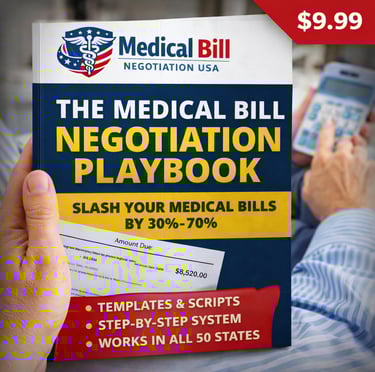
That’s exactly why we created the Medical Bill Negotiation Playbook.
This isn’t generic advice. It’s a tactical system built from real negotiations that have saved people thousands—sometimes tens of thousands—of dollars after ER visits.
If you’re staring at a medical bill right now and thinking “I can’t afford this”, here’s your next move:
👉 Get the Medical Bill Negotiation Playbook
Learn exactly what to say, when to say it, and how to force better outcomes—without stress, confusion, or overpaying.
Because the bill you received is not the bill you have to pay.
And once you know how this game actually works, you never have to lose it again…
continue
again.
…lose it again—and the truth is, what you’ve read so far is only the foundation. The real power comes when you understand how hospitals think internally, how billing departments are incentivized, and how you can press the exact pressure points that trigger concessions they will never volunteer on their own.
From here forward, we’re going deeper. This is where people stop “asking for discounts” and start engineering outcomes.
Inside the Hospital Billing Machine (What They’ll Never Tell You)
Hospitals are not monoliths. They are fragmented bureaucracies with misaligned incentives, internal quotas, and performance metrics that quietly shape how negotiators behave.
If you understand this, you stop feeling intimidated—and start sounding dangerous (in a good way).
Billing Departments Are Measured on “Recovery,” Not Fairness
Billing staff are evaluated on:
Percentage of balances recovered
Speed of resolution
Accounts closed vs. lingering
They are not rewarded for squeezing every dollar out of you.
A closed account at 35% today often looks better internally than an unpaid account at 100% six months from now.
That’s why confident, structured negotiators win.
Supervisors Have More Authority Than Front-Line Reps
The first person you speak to often has limited authority.
Their job is to:
Collect full payment
Offer small “courtesy discounts”
Push payment plans
Your job is to:
Politely bypass them
Escalate to someone with discretion
The magic words?
“I’d like to speak with a supervisor or someone who has settlement authority on this account.”
Say it calmly. Say it early. Say it without apology.
The Psychology of Medical Bill Negotiation (This Matters More Than You Think)
Negotiation is not just numbers. It’s emotional signaling.
Hospitals read you for cues constantly.
What Signals Weakness
Over-explaining your situation
Apologizing repeatedly
Sounding desperate or panicked
Saying “I’ll try to pay something soon”
These signals tell billing staff: Wait them out.
What Signals Strength
Calm, measured tone
Clear boundaries
Willingness to walk away
Prepared offers
You are not asking for mercy. You are proposing a transaction.
That shift alone can cut your bill dramatically.
Advanced Tactic: The “Cash-in-Hand” Close
One of the most powerful negotiation tools is immediacy. https://medicalbillnegotiationusa.com/medical-bill-negotiation-playbook
Hospitals love certainty.
You use that by framing your offer like this:
“I can resolve this today with a lump-sum payment of $X. That’s what I’m able to do right now.”
Notice what’s missing:
No future promises
No payment plans
No emotional pleading
You are offering a bird in the hand.
Hospitals discount heavily for that.
When Insurance Makes Things Worse (Yes, Really)
Many people assume insurance protects them.
After an ER visit, insurance often complicates negotiation.
Why Insured Patients Still Overpay
Insurance-negotiated rates are often still inflated
Patient responsibility can be arbitrary
Insurers deny or partially deny claims routinely
Hospitals know insured patients are less likely to fight.
That’s a mistake.
You Can Negotiate Even After Insurance
Key phrase:
“I’m disputing the patient responsibility amount after insurance. This balance is not reasonable based on the services received.”
Hospitals adjust insured balances quietly all the time.
They just don’t advertise it.
Surprise Billing and the ER: Know Your Rights
Emergency room visits are ground zero for surprise billing.
Out-of-network doctors, labs, and specialists often bill separately—even if the hospital itself is in-network.
The Leverage Point
Surprise billing laws restrict how much out-of-network providers can charge in emergency situations.
If you see an out-of-network charge tied to an ER visit, say this:
“This was emergency care, and I had no ability to choose providers. I’m disputing this under surprise billing protections.”
That sentence alone can trigger internal reviews and reductions.
The “Bill Fatigue” Effect (Why Waiting Helps You)
Hospitals triage accounts.
Your bill moves through phases:
Initial billing
Follow-up notices
Internal collections
External collections
The longer it sits unpaid—but actively disputed—the more flexible they become.
Why?
Because billing departments get tired.
They want closure.
You use that.
Payment Plans: The Trap That Sounds Helpful
Hospitals love payment plans.
Why?
Because once you agree, negotiation usually stops.
Payment plans:
Lock in the full balance
Reduce urgency to discount
Drag out stress for months or years
Only accept a payment plan if:
You’ve already negotiated the balance down
There is no lump-sum option
It’s truly your last resort
Otherwise, payment plans benefit them more than you.
What If They Say “We Don’t Negotiate”?
This is a bluff.
Hospitals negotiate constantly.
When you hear this, respond with:
“Then please note that I’m disputing the charges and cannot pay the full balance. I’ll wait for further review.”
Silence is power.
Accounts under dispute are harder to push into collections.
Using Documentation as Leverage
Every document you request slows billing momentum.
That’s good.
Ask for:
Itemized bills
Coding explanations
Medical necessity justifications
Internal review outcomes
Each request costs them time and money.
You are no longer the problem.
The bill becomes the problem.
Real-World Example: $11,870 ER Bill Reduced to $2,400
Here’s how this plays out in real life.
A patient visits the ER for severe abdominal pain. They are discharged the same night.
They receive:
$7,900 hospital bill
$2,300 physician bill
$1,670 radiology bill
Total: $11,870
What they did:
Requested itemized bills
Challenged the ER visit level
Identified duplicated imaging charges
Claimed financial hardship
Offered lump-sum settlements
Final outcome:
Hospital bill settled for $1,600
Physician bill settled for $500
Radiology bill settled for $300
Total paid: $2,400
No lawyers. No magic. Just leverage and persistence.
Why Hospitals Accept “Ridiculous” Discounts
This is critical to understand emotionally.
Hospitals expect:
A certain percentage of non-payment
A certain percentage of discounts
A certain percentage of write-offs
Your negotiated discount is already baked into their financial models.
You are not bankrupting anyone.
You are operating inside the system as it actually exists.
The One Mistake That Can Ruin Everything
There is one line you should never say:
“I know I owe this…”
That phrase can be interpreted as admitting liability.
Instead, say:
“I’m reviewing and disputing these charges.”
Words matter.
They shape your leverage.
When to Stop Negotiating and Close the Deal
You’ll feel it.
The offer stops improving.
The tone shifts.
They start pushing paperwork.
That’s when you close.
Get it in writing.
Pay exactly what’s agreed.
Save every document.
Then move on with your life—lighter, calmer, and smarter.
The Emotional Aftermath (No One Talks About This)
After negotiating medical bills, people often feel:
Relief
Anger at the system
Empowerment
A desire to help others
That’s normal.
Once you see behind the curtain, you can’t unsee it.
But that knowledge protects you for life.
Why This Process Still Fails for Many People
Even smart, capable adults fail at medical bill negotiation because:
They don’t know the right order of steps
They say the wrong thing early
They accept the first “discount”
They don’t escalate
They get emotionally worn down
Information alone isn’t enough.
Execution matters.
This Is Why the Medical Bill Negotiation Playbook Exists
The Medical Bill Negotiation Playbook exists for one reason:
To remove uncertainty.
Inside it, you get:
Exact call scripts for every stage
Email templates that force responses
Negotiation ranges by bill type
Red flags to watch for
Escalation paths when billing stalls
Checklists so you don’t miss leverage points
It’s designed for real people with real bills—especially after ER visits, where costs explode fast and emotions run high.
If you’re dealing with medical bills right now, don’t guess. Don’t improvise. Don’t overpay.
👉 Get the Medical Bill Negotiation Playbook and take control of the process from start to finish.
Because hospitals negotiate every day.
The question is whether you’ll be on the losing side of that conversation—or the winning one when you pick up the phone and say…
“I’m ready to resolve this account—but not at that price.”
continue
…price.”
And once you say that—with confidence, structure, and zero apology—you step into a completely different role in the system. You are no longer a passive patient. You are an active negotiator.
From here, we go into the deep mechanics: escalation strategies, written disputes, regulatory pressure, and advanced leverage that separates casual negotiators from people who consistently win massive reductions after ER visits.
This is where the system bends.
Advanced Escalation: When Polite Negotiation Isn’t Enough
Most ER bills can be reduced with calm negotiation alone. But when billing departments stall, deflect, or stonewall, escalation becomes your advantage.
Escalation is not aggression.
Escalation is procedural pressure.
The Internal Review Trigger
Hospitals have formal review pathways that are rarely used by patients—because most patients don’t know they exist.
The moment you say:
“I’m formally disputing these charges and requesting an internal review.”
your account changes classification.
Internally, this means:
The bill cannot move forward normally
Supervisory review is required
Documentation must be re-checked
You’ve slowed the machine.
And a slowed machine becomes flexible.
Written Disputes: Why Phone Calls Alone Are Not Enough
Phone calls are powerful—but written disputes create paper trails, which hospitals fear more than complaints.
What a Written Dispute Does
A written dispute:
Forces documentation
Creates compliance obligations
Signals that you understand process
Protects you if the bill goes to collections
You don’t need legal language. You need clarity.
Simple Written Dispute Template (Conceptual)
Your dispute should state:
You are disputing the charges
The bill is under review
The amount is unaffordable or inaccurate
You are requesting reconsideration or adjustment
Once submitted, the clock slows.
That’s leverage.
Using Medical Necessity as a Negotiation Weapon
Hospitals must justify that services billed were medically necessary.
This matters more than most patients realize.
ER Over-Treatment Is Common
ERs frequently:
Order tests “just in case”
Perform imaging as liability protection
Use broad protocols instead of targeted care
That doesn’t automatically mean you should pay for everything at full price.
What to Say
“I’m requesting documentation supporting the medical necessity of these services, particularly the tests and imaging.”
You are not accusing anyone.
You are asking them to work.
Work costs money.
Discounts are cheaper.
The Quiet Power of Compliance Departments
Hospitals are regulated entities.
They have compliance departments whose sole job is to avoid scrutiny, penalties, and complaints.
Most patients never reach them.
You can.
When to Invoke Compliance
If you experience:
Refusal to provide itemized bills
Dismissal of disputes
Repeated billing errors
Surprise out-of-network charges
You escalate by saying:
“I’d like this reviewed by your compliance department.”
This sentence changes tone immediately.
Not because you’re threatening—but because compliance issues create risk, and risk motivates resolution.
Regulatory Pressure (Without Becoming “That Person”)
You do not need to file complaints immediately—but knowing you can is leverage.
Hospitals know that unresolved disputes can escalate to:
State health departments
Insurance regulators
Attorney general offices
You don’t threaten this casually.
You mention it calmly when stalled.
“If this can’t be resolved internally, I’ll need to explore formal complaint options.”
That’s not hostile.
That’s procedural reality.
And it often reopens negotiations instantly.
ER Bills and Credit Reports: What Actually Matters
One of the biggest fear triggers hospitals exploit is credit damage.
Let’s reset reality.
Medical Debt Is Treated Differently
Medical debt:
Has delayed reporting timelines
Is often removed after payment
Is treated more leniently by credit models
Hospitals know this.
They rely on fear, not facts.
Negotiating does not automatically ruin your credit—especially when the bill is actively disputed.
The “Wait and Watch” Strategy (Used Correctly)
Sometimes the best move is to do nothing—strategically.
This works when:
The bill is inflated
You’ve already disputed it
The hospital has gone quiet
Silence shifts urgency to them.
After enough time passes, many hospitals proactively offer:
Deep discounts
Lump-sum settlements
Internal write-offs
Patience is not avoidance.
Patience is pressure.
When to Bring Up Income—And When Not To
Talking about income is optional, not mandatory.
Use Income When:
Applying for financial assistance
Claiming hardship
Negotiating large balances
Avoid Income When:
You’re making lump-sum offers
You want to keep leverage vague
Oversharing weakens your position.
Controlled disclosure strengthens it.
ER Bills for Children, Seniors, and Dependents
Hospitals are especially sensitive to certain patient categories.
These include:
Pediatric patients
Elderly patients
Disabled dependents
Without exploiting sympathy, you can contextualize:
“This ER visit was for my child / elderly parent, and the charges are not sustainable for our household.”
Context humanizes the negotiation without begging.
That balance matters.
The Myth of “Standard Rates”
Hospitals love saying:
“These are our standard rates.”
There is no such thing.
Rates vary based on:
Insurance
Timing
Payment method
Negotiation skill
The moment one patient pays less, the “standard” disappears.
Remember that.
How Hospitals Decide Whether to Write Off Your Bill
Write-offs are not moral judgments.
They are calculations.
Hospitals consider:
Likelihood of payment
Cost of collection
Age of account
Negotiation effort required
If collecting from you feels expensive, slow, or uncertain, discounts become logical.
Your job is to increase friction—politely.
The Emotional Lever Hospitals Don’t Expect
Most people negotiate from fear.
The rare ones negotiate from detachment.
When you sound like:
You’re okay walking away
You’re okay waiting
You’re okay escalating
The balance of power flips.
You are no longer chasing resolution.
They are.
What to Do When You’re Told “This Is the Best We Can Do”
This phrase is often temporary.
Respond with:
“I understand. I’ll need time to consider that. Please keep the account open while I review my options.”
Then pause.
Time erodes rigidity.
ER Bills and Bankruptcy (The Nuclear Option You Rarely Need)
Mentioning bankruptcy is not a threat—it’s a financial reality.
Hospitals know that medical debt is one of the leading causes of bankruptcy.
If appropriate, you can state:
“Given the size of this balance, I’m evaluating all financial options.”
That sentence reframes the negotiation.
Hospitals would rather settle than risk getting nothing.
Why This System Rewards Persistence, Not Intelligence
You don’t need to be smart.
You need to be consistent.
The people who win are not geniuses.
They are:
Calm
Organized
Persistent
Unwilling to accept the first answer
That’s it.
The Long-Term Payoff: Why This Skill Is Worth Mastering
ER visits happen unexpectedly.
Bills follow.
Once you master negotiation:
Fear disappears
Confidence replaces panic
You stop overpaying silently
This skill pays dividends for decades.
The Final Reality Check
Hospitals negotiate every day.
They negotiate with:
Insurance companies
Government programs
Vendors
Debt buyers
You are the only party expected to pay full price without question.
That expectation is optional.
Your Next Move (Don’t Skip This)
If you’ve read this far, you already know something most people don’t:
Medical bills after an ER visit are not fixed outcomes. They are conversations.
But conversations go better with preparation.
The Medical Bill Negotiation Playbook exists to remove guesswork and hesitation at the exact moments that matter most.
Inside, you’ll find:
Word-for-word scripts for ER bills
Dispute templates that work
Settlement benchmarks by bill size
A clear escalation ladder
Mistakes that cost people thousands
If you’re holding an ER bill right now—or you ever expect to again—this is not optional knowledge.
👉 Get the Medical Bill Negotiation Playbook
Use it once, and it can save you more than its cost for the rest of your life.
Because the most expensive ER visit is the one you pay without negotiating—and once you understand how this system really works, you never have to do that again…
Help
Lower your medical bills with expert support
Contact
infoebookusa@aol.com
© 2026. All rights reserved.