How Much Can You Negotiate a Medical Bill? Real Numbers Explained
Blog post description.
2/8/202619 min read
How Much Can You Negotiate a Medical Bill? Real Numbers Explained
If you’ve ever opened a medical bill and felt your stomach drop, you’re not alone. For millions of Americans, medical bills are not just confusing — they’re financially terrifying. A single ER visit, imaging test, or short hospital stay can come with charges that rival the cost of a used car, a year of college tuition, or a down payment on a home.
And here’s the part almost no one tells you clearly:
Medical bills are not fixed prices.https://medicalbillnegotiationusa.com/medical-bill-negotiation-playbook
They are negotiable. Often dramatically so.
But how much can you really negotiate a medical bill?
Is it 5%? 10%? 50%? More?
This article answers that question with real numbers, real scenarios, and real leverage strategies — not vague advice. You’ll see exactly what people are negotiating off medical bills every day, what determines the size of a discount, and how to position yourself to get the maximum reduction possible.
This is not theory. This is how the system actually works.
The Brutal Truth About Medical Billing in America
Before we talk numbers, you need to understand one uncomfortable fact:
Most medical bills are artificially inflated.
Hospitals do not charge patients what care actually costs. They charge based on a complex pricing system called the chargemaster, which is essentially a sticker-price list designed for negotiations with insurance companies — not individuals.
Here’s what that means in practice:
A hospital may charge $12,000 for a procedure
An insurance company may pay $3,800
Medicare may pay $2,200
Medicaid may pay $1,700
A self-pay patient might be billed the full $12,000
Same service. Same doctor. Same room. Vastly different prices.
The inflated number on your bill is not sacred. It’s a starting point.
And hospitals know this.
The Core Question: How Much Can You Negotiate a Medical Bill?
Let’s answer this directly.
Typical medical bill negotiation ranges (realistic):
Self-pay patients: 30%–80% reduction
Insured but denied/underpaid claims: 20%–60% reduction
Out-of-network bills: 40%–70% reduction
Emergency room bills: 30%–65% reduction
Old or unpaid bills: 50%–90% reduction
Financial hardship cases: Up to 100% forgiveness
Yes — in some cases, the bill can be eliminated entirely.
But the exact percentage depends on several factors, which we’ll break down in detail.
Real Negotiation Numbers: Case-by-Case Breakdown
Let’s get specific.
Case 1: Self-Pay ER Visit
Original bill: $9,842
Service: ER visit + CT scan + labs
Insurance: None
What happened:
Patient asked for self-pay discount
Hospital immediately reduced bill to $5,100 (48% off)
Patient then negotiated a lump-sum payment
Final settled amount: $3,200
Total reduction: $6,642
Percentage reduced: 67.5%
This is not unusual.
Hospitals would rather collect $3,200 today than chase $9,842 for years — or send it to collections for pennies on the dollar.
Case 2: Insured Patient, High Deductible
Original bill: $14,300
Insurance adjustment: Paid $6,900
Patient responsibility: $7,400
The patient assumed the $7,400 was non-negotiable.
It wasn’t.
Negotiation steps:
Requested itemized bill
Disputed duplicate lab charges
Requested “financial assistance review”
Asked for prompt-pay discount
Final patient responsibility: $3,950
Reduction on patient portion: 46.6%
Even with insurance, negotiation is possible.
Case 3: Out-of-Network Surgeon Bill
Original bill: $27,450
Insurance paid: $8,200
Balance billed to patient: $19,250
Negotiation result:
Surgeon’s office agreed to accept $6,500 as payment in full
Reduction: $12,750
Percentage reduced: 66%
Out-of-network bills are some of the most negotiable charges in the system.
Case 4: Old Medical Bill in Collections
Original bill: $4,870
Time since service: 18 months
Status: Sent to collections
Negotiation outcome:
Settlement offer accepted at $1,200
Written agreement to remove credit reporting
Reduction: $3,670
Percentage reduced: 75%
Once a bill is in collections, the leverage often shifts toward the patient.
Why Hospitals Agree to Huge Discounts
To understand how far you can negotiate, you need to understand hospital incentives.
Hospitals care about:
Cash flow
Reducing bad debt
Meeting charity care requirements
Avoiding collections costs
Improving balance sheet metrics
They do not expect to collect full chargemaster prices from individuals.
In fact:
Many hospitals assume 30%–40% of self-pay bills will never be paid
Collection agencies often buy debt for 5–15 cents on the dollar
Internal financial assistance programs quietly forgive millions every year
When you negotiate, you’re not asking for a favor.
You’re offering a better financial outcome for both sides.
The Single Biggest Factor That Determines Your Discount
Here’s the most important variable in medical bill negotiation:
Your ability to pay — and your willingness to walk away.
Hospitals negotiate hardest with patients who:
Are self-pay or underinsured
Can pay a lump sum
Are calm, persistent, and informed
Know that bills are negotiable
Hospitals give the biggest discounts when:
The bill is unpaid
The account is close to collections
The patient qualifies for financial assistance
The patient offers immediate payment
If you call once and accept the first “no,” you will get nothing.
If you follow a structured approach, the numbers change fast.
Financial Assistance Programs: The Hidden Weapon
One of the most underused negotiation tools is hospital financial assistance, sometimes called charity care.
Most nonprofit hospitals are legally required to offer it.
Here’s what many people don’t realize:
You do not need to be unemployed
You do not need to be homeless
Middle-income households often qualify
Partial assistance is extremely common
Depending on income and household size:
25%–50% discounts are routine
75%–100% forgiveness happens more than you think
Hospitals rarely advertise this aggressively. You have to ask.
Real Income Examples That Still Qualified for Discounts
These are not extreme poverty cases.
Family of 4 earning $72,000 → 40% reduction
Single adult earning $58,000 → 30% reduction
Married couple earning $85,000 → 25% reduction
Why?
Because hospitals calculate assistance based on:
Income relative to federal poverty levels
Medical expenses relative to income
Local cost of living
Insurance status
The system is more flexible than people assume.
Itemized Bills: Where Discounts Begin
Before negotiating dollars, you negotiate accuracy.
Itemized bills routinely contain:
Duplicate charges
Incorrect codes
Services never received
Upcoded procedures
Unbundled charges
Requesting an itemized bill alone can reduce totals by 5%–20% before negotiation even begins.
Hospitals often prefer to reduce the bill rather than defend every line item.
Emotional Reality: Why This Matters More Than Money
Medical debt is not just a financial issue.
It causes:
Anxiety
Sleep loss
Relationship stress
Career paralysis
Avoidance of future medical care
People delay necessary treatment because they’re afraid of the bill — which creates worse outcomes and higher costs later.
Negotiation is not just about saving money.
It’s about reclaiming control.
And that psychological shift matters.
How Negotiation Percentages Change by Bill Size
Interestingly, larger bills are often easier to negotiate. https://medicalbillnegotiationusa.com/medical-bill-negotiation-playbook
Why?
Because:
The probability of full payment is lower
The hospital’s risk exposure is higher
Collection costs scale with balance size
Typical patterns:
Bills under $1,000 → 10%–30% reduction
Bills $1,000–$5,000 → 25%–50% reduction
Bills $5,000–$20,000 → 40%–70% reduction
Bills $20,000+ → 50%–90% reduction
Yes, a $50,000 bill is often more negotiable than a $500 bill.
Lump-Sum Payments: The Nuclear Option
If you can offer a lump sum, your leverage skyrockets.
Hospitals love certainty.
Example:
Bill: $8,600
Monthly payment plan: $150/month for years
Lump-sum offer: $3,200 today
Many billing departments will take that deal immediately.
Lump-sum discounts often range from 30% to 60%, sometimes more.
The Myth of “Non-Negotiable” Bills
You may hear:
“This is the contracted rate”
“Insurance already adjusted it”
“We can’t change the balance”
“That’s what you owe”
These statements are not lies — but they are not final.
Billing representatives often:
Lack authority
Follow scripts
Expect pushback
Negotiation is a process, not a single phone call.
Persistence changes outcomes.
What Happens If You Do Nothing?
If you don’t negotiate:
The bill may go to collections
Your credit score may be impacted
Interest and fees may accrue
Stress compounds over time
Ironically, many people end up settling later — after damage is done — for less than they could have paid upfront.
Early action = more control.
Negotiation Is Not Confrontation
This is important.
You are not accusing anyone.
You are not being difficult.
You are not asking for charity.
You are engaging in a standard financial process that hospitals deal with every day.
The calm, informed patient almost always does better than the angry or silent one.
How Much Can You Negotiate? The Honest Answer
So, how much can you negotiate a medical bill?
The honest answer is:
Far more than most people ever try.
30% reductions are common
50% reductions are realistic
70% reductions happen daily
100% forgiveness is possible in the right circumstances
The system is built for negotiation — but only if you participate.
And this is where most people get stuck.
They know bills are negotiable…
but they don’t know what to say, who to call, which programs to use, or how to structure the negotiation step by step.
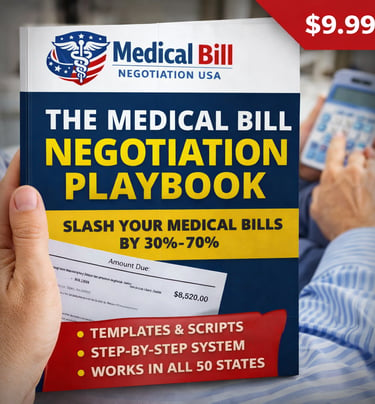
That’s exactly why we created the Medical Bill Negotiation Playbook.
Your Next Step: Take Back Control
The Medical Bill Negotiation Playbook walks you through:
Exact scripts to use with billing departments
How to request itemized bills the right way
How to trigger financial assistance reviews
How to negotiate lump-sum settlements
How to handle insurance denials
How to deal with collections without panic
How to protect your credit while negotiating
This is not generic advice.
It’s a proven, step-by-step system.
If you’re staring at a medical bill right now — or worried one is coming — don’t guess. Don’t hope. Don’t freeze.
Get the Medical Bill Negotiation Playbook and negotiate from a position of strength.
You deserve clarity.
You deserve fairness.
And you deserve to keep your financial future intact — even after a medical emergency.
Because the bill you receive is not the bill you have to pay.
And once you understand that, everything changes.
continue
…And once you truly internalize that reality, the way you look at medical bills changes forever.
From this point forward, we’re going to go deeper — much deeper — into the mechanics, psychology, timing, leverage points, and real-world negotiation tactics that determine exactly how much you can reduce a medical bill, and why some people get massive reductions while others get nothing at all.
This is where most articles stop.
This one doesn’t.
Why Two People With the Same Bill Get Completely Different Outcomes
Let’s start with a question that frustrates almost everyone who has ever tried to negotiate a medical bill:
“Why did my friend get 60% off, but I was told nothing could be done?”
The answer has nothing to do with luck.
It comes down to information asymmetry and negotiation posture.
Hospitals respond very differently depending on:
How you ask
When you ask
Who you ask
What signals you send about payment ability and persistence
Two patients can receive the same $12,000 bill and end up paying wildly different amounts:
Patient A pays $11,500 on a payment plan
Patient B settles for $3,800 in one phone call
Same hospital. Same service. Same bill.
The system didn’t change.
The approach did.
The Hidden Phases of a Medical Bill (And Why Timing Matters)
Medical bills move through predictable internal phases. Negotiation power shifts as the bill moves.
Phase 1: Initial Billing (Weak Leverage)
This is when the bill first arrives.
The hospital is optimistic about full payment
The account is still “clean”
Discounts exist, but they’re modest
Typical reductions in this phase: 10%–30%
This is where many people make the mistake of paying too early.
Phase 2: Early Follow-Ups (Growing Leverage)
30–90 days after billing:
The hospital sees non-payment risk
Payment plans become negotiable
Financial assistance reviews open up
Typical reductions: 25%–50%
This is a strong window if you act intentionally.
Phase 3: Pre-Collections (Peak Leverage)
90–150 days out:
Internal collections begin
The hospital wants resolution
Supervisors have more authority
Typical reductions: 40%–70%
This is often the sweet spot for negotiation.
Phase 4: External Collections (Different Rules)
Once sent to collections:
The hospital may have sold the debt
Or still owns it but outsourced recovery
Typical settlements: 50%–90%
Sometimes even lower.
But credit damage risk increases here — which is why strategy matters.
Why Hospitals Prefer Negotiation Over “Fairness”
Hospitals do not operate on moral fairness. They operate on financial modeling.
From their perspective:
A $10,000 unpaid bill is a liability
A $4,000 immediate payment is an asset
Every day a bill goes unpaid:
Accounting pressure increases
Write-off probability increases
Cash flow worsens
Negotiation solves all of those problems.
Which is why hospitals will say:
“We can’t do anything”
…right up until they suddenly can.
The Psychological Triggers That Unlock Discounts
This is rarely discussed, but it’s critical.
Billing departments are human systems. Certain phrases, behaviors, and signals consistently change outcomes.
Signals That Increase Discounts
Calm, professional tone
Willingness to escalate politely
Clear financial constraints without drama
Specific questions about programs and policies
Mention of lump-sum payment capability
Signals That Reduce Discounts
Emotional outbursts
Threats
Silence or avoidance
Immediate payment without discussion
Accepting the first “no”
Negotiation is not aggression.
It’s controlled persistence.
The Most Powerful Question You Can Ask (Almost No One Does)
Here it is:
“What options are available to reduce this balance?”
Not:
“Can you lower it?”
“This isn’t fair”
“I can’t pay this”
Those invite resistance.
This question invites solutions.
It forces the representative to search:
Discounts
Assistance programs
Supervisor approvals
Alternative billing paths
And once options are on the table, negotiation begins.
Why “Payment Plans” Are a Trap (Most of the Time)
Hospitals love payment plans.
Why?
They delay negotiation
They keep balances high
They reduce urgency
They preserve full billed amounts
Patients think:
“I’ll just do payments and figure it out later”
Later usually means:
Years of payments
No discount
No leverage
Important truth:
Once you’re on a payment plan, negotiating becomes harder — not easier.
Hospitals assume:
You’ve accepted the balance
You’re capable of paying
There’s no need to discount
This is why negotiation should happen before agreeing to a plan.
The “Lump-Sum Illusion” (And How to Use It Even If You Don’t Have Cash)
Here’s something counterintuitive:
You don’t always need the lump sum today to negotiate like you do.
You can say:
“If we can agree on a reduced amount, I can make arrangements to pay it in full.”
This keeps leverage high without committing prematurely.
Once the number is agreed:
You can reassess
Use savings
Borrow short-term
Use a payment method strategically
Never reveal your maximum ability to pay upfront.
How Insurance Complicates (But Doesn’t Eliminate) Negotiation
Many people assume insurance makes negotiation impossible.
It doesn’t.
It just changes the battlefield.https://medicalbillnegotiationusa.com/medical-bill-negotiation-playbook
Common Negotiable Insurance Scenarios
High deductibles
Coinsurance balances
Out-of-network charges
Denied claims
Non-covered services
Balance billing
Insurance sets a framework — not a final price.
Hospitals can:
Reduce patient responsibility
Write off balances
Reclassify charges
Apply hardship discounts
Especially when the patient portion is large.
Why ER Bills Are Especially Negotiable
Emergency rooms are one of the most overpriced parts of the system.
Reasons:
Mandatory treatment laws
No upfront pricing
High uninsured usage
Aggressive chargemaster rates
Hospitals expect:
High non-payment rates
Financial assistance requests
Negotiations
Which means:
ER bills are often discounted 30%–65% without much resistance.
Sometimes more.
The “Silent Discount” Hospitals Don’t Advertise
Many hospitals apply unpublicized internal discounts when patients ask the right way.
These include:
Prompt-pay discounts
Courtesy discounts
Administrative write-offs
Self-pay recalculations
These are not charity.
They are accounting tools.
And they are applied selectively.
Why Middle-Class Patients Are Often the Most Overcharged
Low-income patients:
Qualify for assistance
Often get forgiveness
High-income patients:
Can negotiate aggressively
Offer lump sums
Middle-class patients:
Assume they must pay
Don’t ask
Don’t qualify automatically
Don’t negotiate strategically
This group often overpays the most.
And it’s entirely avoidable.
The Role of Medical Coding in Negotiation Power
Every medical bill is built on codes:
CPT codes
ICD-10 codes
Revenue codes
Coding errors are common.
And even when codes are “correct,” they can be challenged.
Common issues:
Upcoding (billing for higher-level services)
Unbundling (separating what should be grouped)
Duplicate codes
Incorrect modifiers
You don’t need to be a coder — you just need to question.
Once accuracy is questioned, discounts follow.
What Hospitals Rarely Tell You About Charity Care
Hospitals don’t like to talk about this publicly, but it’s true:
Many nonprofit hospitals fail to proactively inform patients about financial assistance — even though they are legally required to offer it.
Why?
It reduces revenue
Most patients don’t ask
Disclosure is minimal
Some hospitals have been sued for this exact behavior.
Which means:
If you don’t ask, you may never be offered help.
How Medical Debt Actually Impacts Credit (And Why This Matters in Negotiation)
Medical debt is treated differently than other debt — but not harmlessly.
Key points:
It may not appear immediately
Smaller balances may be excluded
But unresolved debt can still hurt you
Hospitals know this.
They also know patients fear it.
Negotiation often improves once you show:
Awareness
Willingness to resolve
But not desperation
Fear weakens leverage. Knowledge strengthens it.
The Myth of “Paying It and Fighting Later”
Many people think:
“I’ll pay it now and dispute later.”
This almost always fails.
Once paid:
Leverage disappears
Refunds are difficult
Negotiation ends
Hospitals have no incentive to revisit closed accounts.
Never pay in full until you’ve explored reductions.
Why Negotiation Is Easier Than You Think — And Harder Than You Expect
Easy because:
Discounts already exist
The system expects it
You’re not alone
Hard because:
It requires persistence
Scripts matter
Timing matters
Emotion must be controlled
This is why people fail not because discounts aren’t available — but because they don’t know how to navigate the process.
The Compounding Effect of Negotiation Knowledge
Once you learn this:
You negotiate faster
You panic less
You save more
You avoid future mistakes
Medical bills stop being crises — and become solvable problems.
That mental shift is priceless.
Why DIY Negotiation Often Stalls
Most people:
Make one phone call
Get one “no”
Give up
Hospitals rely on this.
Negotiation usually requires:
Multiple calls
Escalation
Documentation
Follow-up
Without structure, people quit too early.
What Professional Negotiators Do Differently
Medical bill advocates don’t have magic powers.
They:
Know the scripts
Know the leverage points
Know when to escalate
Know when to wait
Know when to settle
You can learn the same process — without paying thousands.
The Cost of Not Negotiating (Over a Lifetime)
Most Americans will face multiple large medical bills in their lives.
If you overpay by:
$2,000 once → painful
$2,000 five times → devastating
$2,000 ten times → life-altering
Negotiation skill compounds financially over decades.
This Is Why the “Medical Bill Negotiation Playbook” Exists
People don’t fail because they’re irresponsible.
They fail because the system is opaque by design.
The Medical Bill Negotiation Playbook exists to remove guesswork.
Inside, you get:
Word-for-word scripts
Exact escalation paths
Timing strategies
Financial assistance triggers
Settlement frameworks
Credit protection tactics
It’s not about being aggressive.
It’s about being prepared.
The Truth That Changes Everything
Here it is — the sentence that reframes medical bills forever:
The price you are billed is not the price you are expected to pay.
Once you understand that:
Fear decreases
Options increase
Outcomes improve
And once you act on it, the savings are real.
If you want to stop guessing, stop overpaying, and stop feeling powerless when medical bills arrive…
Get the Medical Bill Negotiation Playbook.
Because knowledge doesn’t just reduce bills.
It restores control.
And control is exactly what the medical billing system quietly takes from people every day — unless they know how to take it back.
continue
…unless they know how to take it back.
Now let’s go even deeper — into specific dollar thresholds, exact phrases, structural leverage, and the unspoken rules that quietly determine whether your bill drops by a few hundred dollars… or by tens of thousands.
Because at this level, negotiation stops being “asking for help”
and becomes engineering an outcome.
The Exact Dollar Amounts Hospitals Are Psychologically Willing to Accept
Hospitals do not negotiate randomly. They operate within internal approval bands.
These bands are never published — but they exist.
The “No-Approval” Zone
Billing reps often have authority to approve reductions without supervisor approval up to a certain point.
Typical ranges:
10%–20% discount automatically
25% self-pay recalculation
Courtesy or prompt-pay adjustments
If your ask stays inside this zone, resistance is low.
This is why asking for a modest reduction first often opens the door.
The “Supervisor Required” Zone
Once discounts exceed internal thresholds, escalation is required.
This is where larger wins happen.
Common approval points:
40%–50% reductions
Financial hardship discounts
Partial forgiveness
Lump-sum settlements
This is also where most patients stop — because they don’t escalate.
Professionals always do.
The “Write-Off” Zone
At the highest level:
Accounts nearing collections
Low recovery probability
Financial assistance qualification
Administrative cost > recovery value
Here, hospitals may accept:
70%–90% settlements
Zero-balance adjustments
Full forgiveness
These decisions are accounting decisions — not moral ones.
Why Asking “What’s the Best You Can Do?” Is a Mistake
It sounds reasonable. It feels polite.
It’s also ineffective.
Why?
Because it:
Signals passivity
Shifts control to the rep
Invites minimal concessions
Instead, effective negotiators:
Anchor a target
Ask about options
Reference policies
Frame mutual benefit
Negotiation is guided, not begged.
Anchoring: The Most Underused Weapon in Medical Bill Negotiation
Hospitals expect you to react to their numbers.
Flip that.
Example:
“If I could resolve this balance today for $3,500, would that be acceptable?”
Even if the bill is $9,200.
Why this works:
It creates a reference point
It reframes the discussion
It forces evaluation instead of denial
The counteroffer often lands closer to your anchor than the original bill.
Why “I Can’t Afford This” Alone Rarely Works
Financial hardship matters — but only when framed correctly.
Saying:
“I can’t afford this”
…is vague.
Saying:
“Paying this balance would prevent me from meeting essential living expenses”
…is specific.
Hospitals respond to:
Documentation
Ratios
Concrete constraints
Emotion alone doesn’t move accounting systems. Structure does.
The Role of Federal Poverty Levels (Even If You’re Not “Poor”)
Financial assistance is often based on percentages of the Federal Poverty Level (FPL).
Many hospitals offer:
100% forgiveness up to 200% FPL
Partial discounts up to 400% FPL
Sliding-scale reductions beyond that
Here’s the shocker:
A family of four earning over $100,000 may still qualify for partial assistance in high-cost areas.
Most people never check — and overpay as a result.
Why Asking for “Financial Assistance” Is Different Than Asking for a Discount
Discounts are discretionary.
Financial assistance is policy-driven.
Once you request:
The hospital must evaluate
Documentation must be reviewed
The account may be paused
This slows collections and increases leverage.
Even partial approval can reduce balances dramatically.
How Negotiation Outcomes Shift When You Use Paper Instead of Phones
Phone calls are fast — but paper creates pressure.
Written communication:
Creates records
Triggers compliance pathways
Involves higher-level review
A short, professional letter can outperform ten phone calls.
Hospitals take written disputes more seriously.
The “Rebilling” Strategy Almost No One Uses
In some cases, hospitals can:
Reprocess claims
Reclassify services
Apply different self-pay rates
Retroactively apply assistance
This is especially effective when:
Insurance denied claims
Coverage lapsed temporarily
Coding errors occurred
Rebilling can cut bills in half before negotiation even begins.
Why Hospitals Don’t Want You to Know About Internal Cost Floors
Hospitals know their true cost for services.
They rarely disclose it.
But internal cost floors exist.
If:
A CT scan costs $400 internally
And they charge $3,200
Accepting $800 is still profitable
Once you understand this, aggressive negotiation becomes rational — not risky.
The “Time Value of Money” Argument (That Hospitals Quietly Respect)
Hospitals discount future dollars heavily.
Why?
Delayed payment costs money
Collections cost money
Write-offs hurt metrics
When you frame offers as:
“Immediate resolution”
You align with their financial priorities.
Time kills full balances. Speed saves them.
Why Medical Bills Feel Non-Negotiable (By Design)
The system uses:
Complex language
Authority bias
Fear
Deadlines
Opaque pricing
This discourages engagement.
Most people:
Freeze
Pay
Move on
Hospitals know this.
Negotiators exploit the opposite behavior:
Calm
Curious
Persistent
Informed
The Difference Between “Discount” and “Settlement”
This matters.
Discount: Adjusts the balance
Settlement: Resolves the account
Settlements are often larger reductions — but may require lump sums.
Always clarify:
“Payment in full”
“Zero balance confirmation”
“No further billing”
Never assume.
How to Avoid the #1 Negotiation Failure Point
The biggest mistake?
Agreeing verbally without written confirmation.
Always get:
Written agreement
Updated statement
Confirmation email or letter
Without documentation, deals can vanish.
Why Silence Is Sometimes Your Strongest Move
Not every moment requires action.
Strategic pauses:
Increase urgency on their side
Shift follow-up burden
Signal non-desperation
Calling every week without leverage weakens your position.
Timing matters.
The Complicated Truth About Hiring Negotiation Services
Professional negotiators can help — but they:
Take a percentage
Use the same tactics you can
May not fight small balances
For many people, learning the process is more cost-effective.
Especially over a lifetime of bills.
Why Negotiation Success Rates Increase With Preparation — Not Personality
You don’t need to be:
Aggressive
Charismatic
Confident
You need to be:
Structured
Informed
Persistent
Introverts often outperform extroverts in negotiation because they follow process.
The Emotional Shift That Unlocks Better Outcomes
At first, people feel:
Embarrassed
Ashamed
Afraid
Then something changes.
They realize:
The system expects negotiation
They’re not alone
The numbers are flexible
Once fear fades, leverage grows.
The Long-Term Impact of Learning This Once
This is not a one-time skill.
Once you learn:
You negotiate faster
You spot errors instantly
You ask better questions
You save more each time
The return on learning this is enormous.
Why This Knowledge Is Rare (And Valuable)
If everyone negotiated:
Hospital pricing would collapse
Margins would shrink
Transparency would increase
The system relies on ignorance.
That’s why clear guidance is so powerful.
The Point Where People Either Act — Or Overpay
This is that moment.
You can:
Ignore the bill
Pay it in fear
Or take control
Negotiation doesn’t guarantee perfection — but it almost always improves outcomes.
Final Reality Check
Medical bills feel overwhelming because they are designed to.
But behind the intimidation is a system that:
Expects discounts
Allows negotiation
Rewards persistence
The numbers prove it.
If You Want the Exact Scripts, Timing, and Framework
Reading helps.
Structure wins.
The Medical Bill Negotiation Playbook gives you:
Step-by-step actions
Word-for-word language
Escalation maps
Real settlement examples
Credit-safe strategies
So you don’t have to improvise when thousands of dollars are on the line.
Take the Next Step
If you’re facing a medical bill now — or want to be ready for the next one — don’t rely on hope.
Get the Medical Bill Negotiation Playbook.
Because the question isn’t whether medical bills are negotiable.
It’s how much you’re willing to save by learning how to negotiate them correctly… and how much you’ll lose if you don’t.
And that difference can be life-changing.
continue
…and that difference can be life-changing.
Now we’re going to push past general strategy and into precision execution — the exact mechanics that separate small discounts from massive reductions, and hesitation from control.
This is where negotiation becomes systematic.
The Negotiation Stack: Why One Tactic Alone Is Never Enough
Most people try one thing:
Ask for a discount
Mention hardship
Request a payment plan
Professionals stack leverage.
Think of medical bill negotiation as layers:
Accuracy leverage (itemized bill, coding review)
Policy leverage (self-pay rules, assistance programs)
Timing leverage (aging accounts, internal cycles)
Cash leverage (lump-sum or implied lump-sum)
Escalation leverage (authority, supervisors, departments)
Each layer compounds the next.
Use one layer → small win
Use all layers → major reduction
The Itemized Bill Is Not Step One — It’s Step Zero
Requesting an itemized bill is not about curiosity.
It’s about shifting power.
Once you request it:
The account slows down
Collections often pause
The bill enters review mode
The hospital knows you’re not passive
Even if you never find an error, you’ve already gained leverage.
And errors are more common than hospitals admit.
Common “Quiet Errors” That Lead to Instant Reductions
Not every error looks like fraud.
Many are subtle:
Same lab charged twice under different codes
Supplies billed individually instead of bundled
Observation status billed as inpatient
Higher-level ER coding than documentation supports
Charges for services ordered but never performed
Hospitals often reduce rather than argue — because arguing costs more than discounting.
Why You Should Never Reveal Your Financial Ceiling
This is critical.
Never say:
“The most I can pay is…”
That number becomes the floor — not the ceiling.
Instead:
Ask what reductions are possible
Explore programs
Anchor low
Let them counter
Negotiation is discovery, not confession.
The Power of Conditional Offers
Instead of committing, use conditions.
Example:
“If the balance could be reduced significantly, I could look at resolving it in one payment.”
This does three things:
Signals seriousness
Preserves flexibility
Keeps leverage intact
Only finalize after the number improves.
Why “Escalation” Is Not Rudeness
Escalation scares people.
They think:
“I don’t want to be difficult.”
But escalation is normal.
Billing reps:
Have limited authority
Follow scripts
Expect escalation
Politely asking:
“May I speak with someone who can review additional options?”
…is not confrontation.
It’s navigation.
The Invisible Role of Internal Metrics
Hospitals track:
Accounts resolved
Bad debt ratios
Days in accounts receivable
When you negotiate near reporting periods, urgency increases.
End of month
End of quarter
End of fiscal year
These moments quietly improve outcomes.
Why Partial Payments Without Agreement Are Dangerous
Some people send “good faith” payments.
This often backfires.
Why?
It signals ability to pay
It reduces urgency
It may reset collection timelines
Never send money without a written agreement tying it to resolution.
The Strategic Use of Silence (Revisited)
Here’s a counterintuitive truth:
Sometimes the best move after making an offer… is silence.
When you:
Make a reasonable settlement offer
Put it in writing
Then stop talking
You create pressure.
Hospitals hate unresolved accounts more than silence.
When Hospitals Suddenly “Find” a Discount
You’ll hear this:
“Let me check one more thing.”
That’s not random.
It usually means:
Supervisor approval
Policy exception
Internal write-off authority
Stay calm. Stay quiet. Let them work.
The “Too Early” and “Too Late” Problem
Negotiate too early:
Leverage is weak
Optimism is high
Negotiate too late:
Credit risk increases
Stress escalates
The sweet spot is:
After billing
Before external collections
With documentation ready
This is where discounts peak.
Why Medical Debt Is Emotionally Heavier Than Other Debt
Medical debt carries:
No consumer choice
No upfront pricing
No consent to cost
People internalize blame that doesn’t belong to them.
Negotiation helps psychologically because it restores agency.
You didn’t choose the bill — but you can choose how it ends.
The Long Game: Why Hospitals Expect You to Quit
Most patients:
Make one call
Accept the answer
Give up
Hospitals model for this.
Negotiation works because persistence is rare.
Being calm and consistent puts you in the minority — and that’s powerful.
The Difference Between “Fair” and “Acceptable”
Hospitals don’t aim for fairness.
They aim for:
Acceptable recovery
Reduced risk
Administrative efficiency
Your goal isn’t justice.
Your goal is resolution on favorable terms.
Why Confidence Comes From Process, Not Personality
People think negotiators are confident because they succeed.
It’s the opposite.
They succeed because they follow a process — which creates confidence.
Structure removes fear.
The Moment Negotiation Becomes Easy
There’s a point where something clicks.
You stop thinking:
“What if they say no?”
And start thinking:
“Which option makes sense here?”
That’s when negotiation stops being stressful — and starts being strategic.
The Compounding Benefit of Knowing Hospital Language
Once you learn:
“Financial assistance”
“Self-pay recalculation”
“Administrative adjustment”
“Payment in full settlement”
Conversations change.
You’re no longer an outsider.
You’re speaking the system’s language.
Why This Skill Protects You for Life
Medical bills don’t ask permission.
They arrive:
After emergencies
After diagnoses
After surgeries
Learning this once protects you repeatedly.
That’s rare.
The Final Misconception to Let Go Of
Negotiation is not asking for mercy.
It is participating in a system designed for adjustment.
The bill is not a verdict.
It’s an opening offer.
If You Want Zero Guesswork
At this point, you have clarity.
But clarity alone doesn’t give you:
Scripts
Timing
Escalation paths
Documentation templates
That’s what turns knowledge into savings.
The Final Step
If you want to walk into every medical billing conversation knowing:
What to say
When to say it
And when to stop talking
Get the Medical Bill Negotiation Playbook.
Because the question isn’t whether hospitals will negotiate.
They already do.
The real question is whether you’ll be prepared enough to get the numbers that change your life… or whether you’ll pay a price that was never meant to be final.
And now, you know better.
Help
Lower your medical bills with expert support
Contact
infoebookusa@aol.com
© 2026. All rights reserved.