Balance Billing Explained — And How to Stop It
Blog post description.
3/2/202610 min read

Balance Billing Explained — And How to Stop It
If you’ve ever opened a medical bill and felt your stomach drop — this can’t be right — there’s a good chance you were hit with balance billing.
Balance billing is one of the most confusing, infuriating, and financially dangerous practices in American healthcare. It blindsides responsible people who did everything right: chose an in-network hospital, showed their insurance card, paid their copay… and still ended up owing thousands of dollars.
This article explains exactly what balance billing is, why it happens, when it’s illegal, when it’s still allowed, and — most importantly — how to stop it, reduce it, or wipe it out entirely.
This is not theory. This is a tactical, real-world guide written for patients, families, and anyone staring at a bill they cannot — and should not — have to pay. https://medicalbillnegotiationusa.com/medical-bill-negotiation-playbook
What Is Balance Billing? (Plain English)
Balance billing happens when a healthcare provider bills you for the difference between:
what your insurance company agrees to pay
and
what the provider actually charges
That “difference” is the balance — and they send it directly to you.
A Simple Example
Doctor charges: $5,000
Insurance allows: $1,200
Insurance pays: $960
Your copay/coinsurance: $240
If the provider is out-of-network, they may then bill you the remaining $3,800.
That $3,800 is balance billing.
And yes — it’s as brutal as it sounds.
Why Balance Billing Feels Like a Scam (But Isn’t Always Illegal)
From a patient’s perspective, balance billing feels like fraud. You didn’t agree to the price. You didn’t negotiate. You weren’t warned.
But historically, healthcare pricing in the U.S. has been built on provider leverage, not consumer consent.
Providers argue:
“We didn’t agree to your insurer’s rates.”
“We’re allowed to charge our full price.”
“You’re responsible for the rest.”
Patients argue:
“I had no choice.”
“I didn’t even meet this provider.”
“I was unconscious / in an emergency / following instructions.”
Both arguments existed — until federal law started stepping in.
The Two Worlds of Balance Billing: Legal vs Illegal
Balance billing is sometimes legal and sometimes completely illegal.
The difference depends on four critical factors:
Emergency vs non-emergency care
In-network vs out-of-network
Type of provider
Whether proper notice and consent were given
Understanding these distinctions is the key to fighting back.
Emergency Care: Where Balance Billing Is Mostly Illegal
If you receive emergency care, balance billing is generally prohibited.
This includes:
ER visits
Ambulance transport (with exceptions)
Emergency surgeries
Stabilizing treatment
Why?
Because in emergencies:
You cannot shop for providers
You cannot verify networks
You cannot consent meaningfully
The law recognizes this.
The No Surprises Act (The Game Changer)
As of January 1, 2022, the No Surprises Act dramatically restricted balance billing.
Under this law, you cannot be balance billed for:
Emergency services
Emergency air ambulance services
Non-emergency services at in-network hospitals performed by out-of-network providers
This includes:
Anesthesiologists
Radiologists
Pathologists
Assistant surgeons
Hospitalists
ER physicians
These are the classic “I never met this person” bills.
The Most Common Balance Billing Trap
Here’s the scenario that traps millions of people every year:
You go to an in-network hospital
You verify the hospital is covered
You have a procedure
Weeks later, separate bills arrive from:
Anesthesiology
Radiology
Emergency physician group
One or more are out-of-network
You’re billed thousands
This is exactly what the No Surprises Act was designed to stop.
If this happened after January 1, 2022 — there is a very high chance the bill is illegal.
When Balance Billing Is Still Allowed
Balance billing hasn’t disappeared completely. Providers found the edges.
Balance billing may still be allowed if:
You received non-emergency care
The provider was out-of-network
You were given proper written notice
You explicitly consented to out-of-network charges
That consent must be:
In writing
Given at least 72 hours in advance (or same-day in limited cases)
Clear about costs
Not coerced
Most “consents” fail these requirements.
Surprise Bills vs Balance Bills (Not the Same)
People often confuse these terms.
Surprise bill: a bill you didn’t expect
Balance bill: the difference between charges and insurance payment
A surprise bill can be:
Legal
Illegal
Negotiable
A balance bill can be:
Prohibited by law
Fully enforceable
Strategically reducible
The strategy depends on which one you’re facing.
How Providers Justify Balance Billing
Understanding the enemy helps you defeat it.
Providers argue:
Insurance payments are too low
Negotiations failed
They deserve “fair market value”
But here’s the truth patients never hear:
Chargemaster prices are inflated by design.
Hospitals routinely:
Inflate list prices by 300–1000%
Expect insurers to negotiate down
Use balance billing as leverage
Patients become collateral damage.
The Emotional Impact (Why This Hurts So Much)
Balance billing isn’t just financial — it’s psychological.
Patients report:
Anxiety
Sleeplessness
Shame
Fear of collections
Fear of credit damage
Anger at insurers and hospitals
People who did nothing wrong feel punished.
This emotional pressure is often used intentionally — silence, deadlines, threats — to force payment.
First Rule: Never Pay a Balance Bill Immediately
The worst move you can make is paying out of fear.
Once you pay:
Leverage disappears
Disputes become harder
Refunds are rare
Balance bills are not like utility bills. They are negotiable, challengeable, and often illegal.
Step 1: Identify Whether the Bill Is Illegal
Before negotiating, you must classify the bill.
Ask these questions:
Was the care emergency?
Was the hospital in-network?
Is the provider someone I never chose?
Was this after January 1, 2022?
Did I sign explicit out-of-network consent?
If the answers line up, the bill may violate federal law.
Step 2: Demand a Corrected Bill
If you suspect illegal balance billing:
Contact the provider’s billing department
State clearly:
“This appears to be a prohibited balance bill under the No Surprises Act.”
Do not argue emotionally.
Do not explain your finances.
Do not offer payment.
Ask for:
A corrected bill
Reprocessing under in-network rules
Written confirmation
Step 3: Loop in Your Insurance Company (Strategically)
Insurance companies hate surprise bills — but only when forced.
Call and say:
You are disputing a balance bill
It may violate federal law
You want the claim reprocessed
Request:
A formal review
Escalation to a supervisor
Written determination
Document everything.https://medicalbillnegotiationusa.com/medical-bill-negotiation-playbook
Step 4: File a Federal Complaint (When Needed)
If the provider refuses to budge:
You can file a complaint with:
The Centers for Medicare & Medicaid Services (CMS)
This triggers:
Provider scrutiny
Mandatory responses
Risk of fines for the provider
Many bills “magically disappear” at this stage.
When the Bill Is Legal — You Still Have Power
Even legal balance bills are rarely final.
Providers expect:
Non-payment
Negotiation
Discounts
Hospitals routinely accept:
10%
20%
50%
Even 80% reductions
Especially when:
You pay in a lump sum
You demonstrate hardship
You push back confidently
The Psychology of Medical Bill Negotiation
Hospitals operate on volume, not individual patients.
Billing departments:
Have scripts
Have authority thresholds
Have quotas for recoveries
They are trained to:
Delay
Confuse
Intimidate gently
But they are also trained to settle.
Common Mistakes That Cost Patients Thousands
Saying “I can’t afford this” too early
Admitting liability
Making small “good faith” payments
Ignoring deadlines without response
Trusting verbal promises
Failing to escalate
Medical billing is a chess match, not a phone call.
Real-World Example: $14,200 Reduced to $1,800
A patient received:
Emergency surgery
In-network hospital
Out-of-network surgeon bill
Initial bill: $14,200
After:
Legal citation
Written dispute
Insurance escalation
Final amount owed: $1,800
No lawsuit. No lawyer. Just strategy.
Why Hospitals Don’t Advertise Your Rights
If patients understood balance billing laws:
Revenue would drop
Negotiation rates would rise
Leverage would shift
Complexity protects profits.
Clarity protects patients.
What to Do If the Bill Goes to Collections
Even collections aren’t the end.
Key facts:
Medical debt has special credit rules
Many debts are sold for pennies
Validation requests can stop action
Disputes can pause reporting
You are not powerless — even late in the process.
Balance Billing and Credit Damage (The Truth)
As of recent credit reporting changes:
Paid medical collections may be removed
Small balances may not be reported
Disputed debts must be flagged
Fear is often worse than reality.
The Difference Between Negotiating Yourself vs Using a Playbook
You can negotiate on your own.
But most people:
Don’t know what to say
Don’t know when to push
Don’t know when to escalate
Don’t know the leverage points
That’s where structure changes outcomes.
Why This Keeps Happening (And Why It Won’t Stop Soon)
Despite laws:
Providers test boundaries
Enforcement lags
Patients don’t challenge bills
Complexity protects revenue
Balance billing survives on silence.
The Moment That Changes Everything
The moment you stop asking:
“How do I pay this?”
And start asking:
“Why do I owe this?”
That shift alone saves people thousands.
What Comes Next (And What You Should Do Right Now)
If you are holding a balance bill:
Do not panic
Do not pay immediately
Do not assume it’s valid
There is a process.
There is leverage.
There is a path forward.
And if you want that process laid out step by step, with scripts, templates, escalation paths, and real negotiation language that actually works…
Final Call to Action
Don’t guess. Don’t wing it. Don’t overpay.
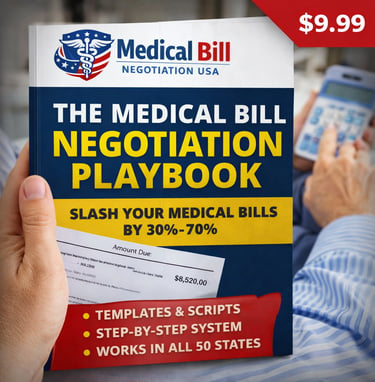
The Medical Bill Negotiation Playbook shows you:
Exactly how to identify illegal balance bills
The precise language to shut them down
How to force insurers and hospitals to reprocess claims
Proven negotiation strategies that cut bills by 50–90%
What to do at every stage — from first notice to collections
If balance billing hit you — or might hit you — this playbook pays for itself the first time you use it.
Get the Medical Bill Negotiation Playbook now — before you pay another dollar you don’t owe.
And remember:
Medical bills are not final. Power belongs to the informed patient.
https://medicalbillnegotiationusa.com/medical-bill-negotiation-playbook
And that power doesn’t end with understanding balance billing. It begins there.
The Hidden Mechanics Behind Balance Billing (What Providers Don’t Want You to Know)
To fully stop balance billing, you need to understand how it survives inside hospital billing systems.
Most patients imagine billing as a simple pipeline:
Treatment → Insurance → Final bill
That is not how it works.
In reality, billing is layered, fragmented, and intentionally opaque.
Inside a Hospital Billing Ecosystem
A single hospital visit can generate bills from:
The hospital itself
A physician group
An anesthesia group
A radiology contractor
A pathology lab
An emergency physician staffing company
A surgical assistant group
A facility fee entity
Each one may:
Have different networks
Use different billing software
Follow different legal interpretations
Pursue payment independently
This fragmentation is why balance billing thrives.
Why “In-Network Hospital” Does NOT Mean “In-Network Care”
This is one of the most dangerous misconceptions in healthcare.
Hospitals often:
Lease departments to third parties
Contract physician groups
Outsource entire specialties
You may never meet the company that bills you.
That disconnect allows providers to say:
“We’re not part of the hospital network.”
The No Surprises Act was written specifically to stop this abuse — but only if patients invoke it correctly.
The Consent Trap: How Providers Try to Bypass the Law
Many providers attempt to preserve balance billing by using flawed consent forms.
Common tactics include:
Buried clauses in intake paperwork
Vague language like “may incur additional charges”
Forms signed under stress
Electronic signatures without explanation
Consent after care has already begun
Legally, most of these do not qualify as valid consent.
Valid consent must:
Be specific
Identify the out-of-network provider
State estimated charges
Be voluntary
Be provided in advance
Offer a meaningful in-network alternative
If any of those elements are missing, the consent can be challenged.
How to Analyze a Consent Form Like an Expert
If a provider claims you “agreed” to balance billing, ask for:
The signed consent document
Date and time of signature
Cost estimate disclosure
Proof of in-network alternative offered
Then look for:
Generic language
Missing dollar amounts
Same-day signatures
Emergency context
Lack of alternatives
These weaknesses are leverage.
Balance Billing and Ambulances: A Special Warning
Ground ambulances are a notorious loophole.
While air ambulances are covered by federal law, ground ambulances are often not.
This creates massive bills — sometimes $5,000 to $15,000 — for unavoidable transport.
However:
Many states regulate this
Many bills are negotiable
Many charges exceed “reasonable and customary” rates
Never assume ambulance bills are fixed.
The “Out-of-Network on Purpose” Strategy
Some providers intentionally stay out-of-network.
Why?
Higher leverage
Higher list prices
Less insurer control
These providers rely on:
Patient ignorance
Fear
Time pressure
But here’s the key insight:
Out-of-network does not mean non-negotiable.
In fact, it often means the opposite.
Why Insurance “Allowed Amounts” Matter More Than Charges
Hospitals quote massive numbers.
But what matters is:
What insurers actually pay
What Medicare pays
What similar providers accept
These benchmarks expose inflated pricing.
When negotiating, always reference:
In-network allowed amounts
Medicare reimbursement rates
Geographic averages
Never argue emotionally.
Argue comparatively.
The Power of the “Reasonable Rate” Argument
Providers are required to charge reasonable rates.
That standard is vague — but powerful.
If:
Your insurer allows $1,200
Medicare allows $850
The provider demands $6,000
You can challenge the bill as unreasonable.
This argument works best:
In writing
With benchmarks
With escalation
How Hospitals Decide Whether to Fight You or Fold
Billing departments triage accounts.
They evaluate:
Amount owed
Likelihood of payment
Patient persistence
Legal exposure
Administrative cost
Patients who:
Write formal disputes
Cite laws
Request itemization
Escalate calmly
…are often flagged as “high friction” — and offered settlements.
Why Itemized Bills Are a Weapon
Always request an itemized bill.
Why?
Because itemization:
Exposes duplicate charges
Reveals unbundling
Identifies errors
Slows collections
Signals seriousness
Many inflated bills collapse under scrutiny.
Common Itemization Abuses
Watch for:
Separate charges for bundled services
Duplicate supply fees
“Miscellaneous” charges
Excessive time units
Facility fees without justification
Each line item is negotiable.
The Silent Role of Medical Coding Errors
Up to 80% of medical bills contain errors.
Common issues:
Incorrect CPT codes
Upcoding
Unnecessary modifiers
Services not rendered
Incorrect dates
Coding errors are leverage bombs.
How to Trigger an Internal Audit Without Saying “Audit”
Use language like:
“I am requesting a full coding review and charge validation.”
This:
Forces internal review
Delays collections
Often results in reductions
Hospitals do not want audits.
The Myth of “This Is the Final Bill”
Medical bills are rarely final.
They are:
Opening offers
Anchors
Negotiation starting points
Providers expect pushback — even if they pretend otherwise.
The Timing Advantage Most Patients Miss
Negotiation power changes over time.
Strongest leverage points:
Immediately after billing
Before collections
After internal review
Before debt sale
Worst time to negotiate:
After paying
After admitting liability
After ignoring notices completely
Timing matters.
Scripts That Change the Conversation Instantly
Compare these two approaches:
❌ “I can’t afford this.”
✅ “I’m disputing this charge as unreasonable and potentially prohibited.”
One invites sympathy.
The other triggers compliance.
Why Threats Don’t Work — But Consequences Do
Never threaten lawsuits casually.
Instead:
Reference regulatory complaints
Mention formal disputes
Ask for written determinations
Calm authority beats anger every time.
What Happens When You File a Formal Dispute
Formal disputes:
Freeze collections
Trigger compliance reviews
Create paper trails
Shift leverage
Most providers prefer discounts over disputes.
The “Silence Strategy” (When to Stop Talking)
After submitting:
A written dispute
Legal citation
Documentation request
Stop calling.
Let the provider respond.
Silence forces action.
When to Accept a Settlement (And When Not To)
Accept a settlement when:
The reduction is substantial
The bill is legally valid
The terms are in writing
The account is resolved fully
Never accept:
Partial settlements without confirmation
Verbal promises
Payment plans without reductions
Payment Plans: The Hidden Trap
Payment plans often:
Lock in full liability
Reset collection timelines
Eliminate negotiation leverage
Only use payment plans after negotiation.
Medical Debt Forgiveness Programs (Often Unadvertised)
Hospitals quietly offer:
Charity care
Financial assistance
Hardship reductions
Even middle-income patients may qualify.
Ask specifically for:
Financial assistance applications
Charity care policies
Income thresholds
Many hospitals forgive bills quietly.
Why Shame Keeps People Overpaying
Healthcare billing relies on:
Confusion
Guilt
Fear
But medical debt is not moral failure.
It’s a pricing failure.
Balance Billing and Families: A Special Warning
Parents, spouses, and caregivers are frequent targets.
Common tactics include:
Billing the wrong guarantor
Pressuring family members
Confusing responsibility
Always verify:
Who is legally responsible
Whose name is on the bill
Whether consent applies
When to Bring in Professional Help
Sometimes leverage isn’t enough.
Consider professional help if:
The bill exceeds $10,000
Legal complexity is high
Multiple providers are involved
Collections are aggressive
But even professionals follow the same playbook — just faster.
Why This System Persists (And Why Patients Must Push Back)
Balance billing survives because:
Patients assume bills are fixed
Laws are underused
Providers test compliance
Enforcement is complaint-driven
Silence enables abuse.
The Long-Term Cost of Not Fighting
Overpaying medical bills:
Drains savings
Delays goals
Damages credit
Creates ongoing stress
Fighting back once builds confidence forever.
The Moment Patients Regret Most
Ask anyone who overpaid:
“What do you wish you’d done?”
The answer is always the same:
“I wish I’d challenged it.”
The Playbook Exists Because Guessing Is Expensive
Every mistake in medical billing negotiation costs money.
Wrong words.
Wrong timing.
Wrong assumptions.
Structure prevents loss.
The Final Truth About Balance Billing
Balance billing is not just a billing issue.
It’s a power imbalance.
But power shifts when patients:
Understand the rules
Use the right language
Apply pressure strategically
Refuse to accept unjust charges
The Real Ending (And the Real Beginning)
If you are dealing with a balance bill — now or in the future — you have two options:
Hope it’s fair
Know how to fight
The Medical Bill Negotiation Playbook exists so you never have to guess again.
It gives you:
Exact scripts
Legal references
Negotiation frameworks
Escalation paths
Real-world strategies that work
Not theory.
Not fluff.
Just leverage.
Get the Medical Bill Negotiation Playbook today — and stop paying bills you don’t legally or ethically owe.
Because the system counts on silence.
And informed patients don’t stay silent.
Help
Lower your medical bills with expert support
Contact
infoebookusa@aol.com
© 2026. All rights reserved.